Advertisements
Advertisements
प्रश्न
Find the maximum magnitude of the linear momentum of a photoelectron emitted when a wavelength of 400 nm falls on a metal with work function 2.5 eV.
(Use h = 6.63 × 10⁻³⁴J-s = 4.14 × 10⁻¹⁵ eV-s, c = 3 × 10⁸ m/s and me = 9.1 × 10⁻³¹kg)
Advertisements
उत्तर
Given :-
wavelength of light , `λ = 400 "nm" = 400 xx 10^-9 "m"`
Work function of metal, `phi = 2.5 "eV"`
From Einstein's photoelectric equation,
Kinetic energy = `(hc)/λ - phi`
Here, c = speed of light
h = Planck's constant
`therefore K.E. = (6.63 xx 10^-34 xx 3 xx 10^8)/(4 xx 10^-7 xx 1.6 xx 10^-19) - 2.5 "eV"`
`= 0.605 "eV"`
Also , `K.E. = p^2/(2m)`
where p is momentum and m is the mass of an electron.
`therefore p^2 = 2"m" xx K.E.`
`⇒ p^2 = 2 xx 9.1 xx 10^-31 xx 0.605 xx 1.6 xx 10^-19`
`⇒ p = 4.197 xx 10^-25 "kg - m/s"`
APPEARS IN
संबंधित प्रश्न
Is it always true that for two sources of equal intensity, the number of photons emitted in a given time are equal?
In an experiment on photoelectric effect, a photon is incident on an electron from one direction and the photoelectron is emitted almost in the opposite direction. Does this violate the principle of conservation of momentum?
It is found that photosynthesis starts in certain plants when exposed to sunlight, but it does not start if the plants are exposed only to infrared light. Explain.
Two photons of
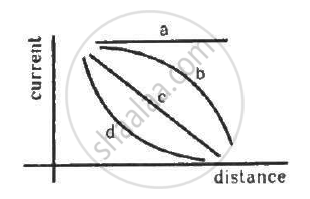
A point source causes photoelectric effect from a small metal plate. Which of the following curves may represent the saturation photocurrent as a function of the distance between the source and the metal?
A photon of energy hv is absorbed by a free electron of a metal with work-function hv − φ.
If the wavelength of light in an experiment on photoelectric effect is doubled,
(a) photoelectric emission will not take place
(b) photoelectric emission may or may not take place
(c) the stopping potential will increase
(d) the stopping potential will decrease
A sphere of radius 1.00 cm is placed in the path of a parallel beam of light of large aperture. The intensity of the light is 0.5 W cm−2. If the sphere completely absorbs the radiation falling on it, find the force exerted by the light beam on the sphere.
(Use h = 6.63 × 10⁻³⁴J-s = 4.14 × 10⁻¹⁵ eV-s, c = 3 × 10⁸ m/s and me = 9.1 × 10⁻³¹kg)
Find the maximum kinetic energy of the photoelectrons ejected when light of wavelength 350 nm is incident on a cesium surface. Work function of cesium = 1.9 eV
(Use h = 6.63 × 10⁻³⁴J-s = 4.14 × 10⁻¹⁵ eV-s, c = 3 × 10⁸ m/s and me = 9.1 × 10⁻³¹kg)
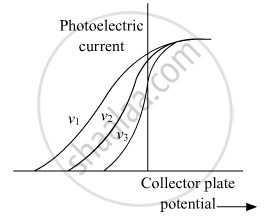
On the basis of the graphs shown in the figure, answer the following questions :
(a) Which physical parameter is kept constant for the three curves?
(b) Which is the highest frequency among v1, v2, and v3?
In the case of photoelectric effect experiment, explain the following facts, giving reasons.
The photoelectric current increases with increase of intensity of incident light.
Define the term: stopping potential in the photoelectric effect.
Explain how does (i) photoelectric current and (ii) kinetic energy of the photoelectrons emitted in a photocell vary if the frequency of incident radiation is doubled, but keeping the intensity same?
Show the graphical variation in the above two cases.
Do all the electrons that absorb a photon come out as photoelectrons?
The graph shows the variation of photocurrent for a photosensitive metal
- What does X and A on the horizontal axis represent?
- Draw this graph for three different values of frequencies of incident radiation ʋ1, ʋ2 and ʋ3 (ʋ3 > ʋ2 > ʋ1) for the same intensity.
- Draw this graph for three different values of intensities of incident radiation I1, I2 and I3 (I3 > I2 > I1) having the same frequency.
Which theory cannot completely explain important observations of photoelectric emission?
Which part provides an entry point for incident radiation?
After applying a potential difference, how is the resulting photocurrent measured?
Why is the polarity reversed during the procedure?
What happens if the frequency of incident radiation is below the threshold frequency?
