Advertisements
Advertisements
प्रश्न
Consider a 20 W bulb emitting light of wavelength 5000 Å and shining on a metal surface kept at a distance 2 m. Assume that the metal surface has work function of 2 eV and that each atom on the metal surface can be treated as a circular disk of radius 1.5 Å.
- Estimate no. of photons emitted by the bulb per second. [Assume no other losses]
- Will there be photoelectric emission?
- How much time would be required by the atomic disk to receive energy equal to work function (2 eV)?
- How many photons would atomic disk receive within time duration calculated in (iii) above?
- Can you explain how photoelectric effect was observed instantaneously?
Advertisements
उत्तर
According to the problem, P = 20 W, λ = 5000 Å = 5000 × 10–10 m, distance (d) = 2 m, work function `phi_0` = 2 eV, radius r = 1.5 Å = 1.5 × 10⁻¹⁰ m
Now, Number of photon emitted by bulb per second, n' = `(dN)/(dt)`
i. Number of photon emitted by bulb per second is n’ = `(P)/((hc)/λ) = (Pλ)/(hc)`
= `(20 xx (5000 xx 10^-10))/((6.62 xx 10^-34) xx (3 xx 10^8))`
⇒ n' = 5 × 10¹⁹/sec
ii. Energy of the incident photon = `(hc)/λ`
= `((6.62 xx 10^-34) xx (3 xx 10^8))/(5000 xx 10^-10 xx 1.6 xx 10^-19)`
= 2.48 ev
As this energy is greater than 2 eV (i.e., a work function of the metal surface), hence photoelectric emission takes place.
iii. Let Δt be the time spent in getting the energy `phi` = (work function of metal).
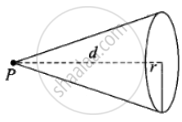
Consider the figure, if P is the power of source then energy received by the atomic disc
`p/(4πd^2) xx pir^2Δt = phi_0`
⇒ Δt = `(4phi_0d^2)/(Pr^2)`
= `(4 xx (2 xx 1.6 xx 10^-19) xx 2^2)/(20 xx (1.5 xx 10^-10)^2`
= 2.84 s
iv. Number of photons received by the atomic disc in time Δt is
N = `(n^' xx pir^2)/(4pid^2) xx Δt`
= `(n^'r^2Δt)/(4d^2)`
= `((5 xx 10^19) xx (1.5 xx 10^-10)^2 xx 28.4)/(4 xx (2)^2`
= 2
Now let us discuss the last part in detail. As the time of emission of electrons is 11.04 s.
v. In photoelectric emission, there is a collision between the incident photon and free electron of the metal surface, which lasts for a very short interval of time (≈ 10–9 s), hence we say photoelectric emission is instantaneous.
APPEARS IN
संबंधित प्रश्न
The photoelectric cut-off voltage in a certain experiment is 1.5 V. What is the maximum kinetic energy of photoelectrons emitted?
A mercury lamp is a convenient source for studying frequency dependence of photoelectric emission, since it gives a number of spectral lines ranging from the UV to the red end of the visible spectrum. In our experiment with rubidium photo-cell, the following lines from a mercury source were used:
λ1 = 3650 Å, λ2 = 4047 Å, λ3 = 4358 Å, λ4 = 5461 Å, λ5 = 6907 Å,
The stopping voltages, respectively, were measured to be:
V01 = 1.28 V, V02 = 0.95 V, V03 = 0.74 V, V04 = 0.16 V, V05 = 0 V
Determine the value of Planck’s constant h, the threshold frequency and work function for the material.
[Note: You will notice that to get h from the data, you will need to know e (which you can take to be 1.6 × 10⁻¹⁹ C). Experiments of this kind on Na, Li, K, etc. were performed by Millikan, who, using his own value of e (from the oil-drop experiment) confirmed Einstein’s photoelectric equation and at the same time gave an independent estimate of the value of h.]
If an electron has a wavelength, does it also have a colour?
If the frequency of light in a photoelectric experiment is doubled, the stopping potential will ______.
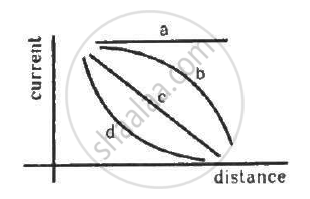
A point source causes photoelectric effect from a small metal plate. Which of the following curves may represent the saturation photocurrent as a function of the distance between the source and the metal?
If the wavelength of light in an experiment on photoelectric effect is doubled,
(a) photoelectric emission will not take place
(b) photoelectric emission may or may not take place
(c) the stopping potential will increase
(d) the stopping potential will decrease
In which of the following situations, the heavier of the two particles has smaller de Broglie wavelength? The two particles
(a) move with the same speed
(b) move with the same linear momentum
(c) move with the same kinetic energy
(d) have fallen through the same height
A beam of white light is incident normally on a plane surface absorbing 70% of the light and reflecting the rest. If the incident beam carries 10 W of power, find the force exerted by it on the surface.
(Use h = 6.63 × 10⁻³⁴J-s = 4.14 × 10⁻¹⁵ eV-s, c = 3 × 10⁸ m/s and me = 9.1 × 10⁻³¹kg)
The work function of a photoelectric material is 4.0 eV. (a) What is the threshold wavelength? (b) Find the wavelength of light for which the stopping potential is 2.5 V.
(Use h = 6.63 × 10⁻³⁴J-s = 4.14 × 10⁻¹⁵ eV-s, c = 3 × 10⁸ m/s and me = 9.1 × 10⁻³¹kg)
The electric field associated with a light wave is given by `E = E_0 sin [(1.57 xx 10^7 "m"^-1)(x - ct)]`. Find the stopping potential when this light is used in an experiment on photoelectric effect with the emitter having work function 1.9 eV.
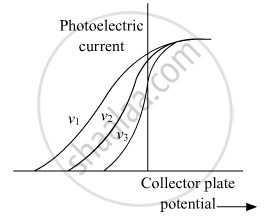
On the basis of the graphs shown in the figure, answer the following questions :
(a) Which physical parameter is kept constant for the three curves?
(b) Which is the highest frequency among v1, v2, and v3?
The graph shows the variation of photocurrent for a photosensitive metal
- What does X and A on the horizontal axis represent?
- Draw this graph for three different values of frequencies of incident radiation ʋ1, ʋ2 and ʋ3 (ʋ3 > ʋ2 > ʋ1) for the same intensity.
- Draw this graph for three different values of intensities of incident radiation I1, I2 and I3 (I3 > I2 > I1) having the same frequency.
How would the stopping potential for a given photosensitive surface change if the intensity of incident radiation was decreased? Justify your answer.
- Assertion (A): For the radiation of a frequency greater than the threshold frequency, the photoelectric current is proportional to the intensity of the radiation.
- Reason (R): Greater the number of energy quanta available, the greater the number of electrons absorbing the energy quanta and the greater the number of electrons coming out of the metal.
What is the effect of threshold frequency and stopping potential on increasing the frequency of the incident beam of light? Justify your answer.
Which part is the photosensitive metal plate?
What changes the polarity between the plates?
After applying a potential difference, how is the resulting photocurrent measured?
How quickly does photoelectric emission occur when suitable radiation falls on the metal surface?
