Advertisements
Advertisements
Question
Consider a 20 W bulb emitting light of wavelength 5000 Å and shining on a metal surface kept at a distance 2 m. Assume that the metal surface has work function of 2 eV and that each atom on the metal surface can be treated as a circular disk of radius 1.5 Å.
- Estimate no. of photons emitted by the bulb per second. [Assume no other losses]
- Will there be photoelectric emission?
- How much time would be required by the atomic disk to receive energy equal to work function (2 eV)?
- How many photons would atomic disk receive within time duration calculated in (iii) above?
- Can you explain how photoelectric effect was observed instantaneously?
Advertisements
Solution
According to the problem, P = 20 W, λ = 5000 Å = 5000 × 10–10 m, distance (d) = 2 m, work function `phi_0` = 2 eV, radius r = 1.5 Å = 1.5 × 10⁻¹⁰ m
Now, Number of photon emitted by bulb per second, n' = `(dN)/(dt)`
i. Number of photon emitted by bulb per second is n’ = `(P)/((hc)/λ) = (Pλ)/(hc)`
= `(20 xx (5000 xx 10^-10))/((6.62 xx 10^-34) xx (3 xx 10^8))`
⇒ n' = 5 × 10¹⁹/sec
ii. Energy of the incident photon = `(hc)/λ`
= `((6.62 xx 10^-34) xx (3 xx 10^8))/(5000 xx 10^-10 xx 1.6 xx 10^-19)`
= 2.48 ev
As this energy is greater than 2 eV (i.e., a work function of the metal surface), hence photoelectric emission takes place.
iii. Let Δt be the time spent in getting the energy `phi` = (work function of metal).
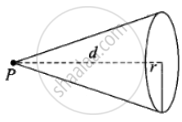
Consider the figure, if P is the power of source then energy received by the atomic disc
`p/(4πd^2) xx pir^2Δt = phi_0`
⇒ Δt = `(4phi_0d^2)/(Pr^2)`
= `(4 xx (2 xx 1.6 xx 10^-19) xx 2^2)/(20 xx (1.5 xx 10^-10)^2`
= 2.84 s
iv. Number of photons received by the atomic disc in time Δt is
N = `(n^' xx pir^2)/(4pid^2) xx Δt`
= `(n^'r^2Δt)/(4d^2)`
= `((5 xx 10^19) xx (1.5 xx 10^-10)^2 xx 28.4)/(4 xx (2)^2`
= 2
Now let us discuss the last part in detail. As the time of emission of electrons is 11.04 s.
v. In photoelectric emission, there is a collision between the incident photon and free electron of the metal surface, which lasts for a very short interval of time (≈ 10–9 s), hence we say photoelectric emission is instantaneous.
APPEARS IN
RELATED QUESTIONS
Monochromatic radiation of wavelength 640.2 nm (1 nm = 10−9 m) from a neon lamp irradiates photosensitive material made of caesium on tungsten. The stopping voltage is measured to be 0.54 V. The source is replaced by an iron source and its 427.2 nm line irradiates the same photo-cell. Predict the new stopping voltage.
Is it always true that for two sources of equal intensity, the number of photons emitted in a given time are equal?
Can a photon be deflected by an electric field? Or by a magnetic field?
It is found that yellow light does not eject photoelectrons from a metal. Is it advisable to try with orange light or with green light?
When stopping potential is applied in an experiment on photoelectric effect, no photoelectric is observed. This means that
When the intensity of a light source in increased,
(a) the number of photons emitted by the source in unit time increases
(b) the total energy of the photons emitted per unit time increases
(c) more energetic photons are emitted
(d) faster photons are emitted
Photoelectric effect supports quantum nature of light because
(a) there is a minimum frequency below which no photoelectrons are emitted
(b) the maximum kinetic energy of photoelectrons depends only on the frequency of light and not on its intensity
(c) even when the metal surface is faintly illuminated the photoelectrons leave the surface immediately
(d) electric charge of the photoelectrons is quantised
If the wavelength of light in an experiment on photoelectric effect is doubled,
(a) photoelectric emission will not take place
(b) photoelectric emission may or may not take place
(c) the stopping potential will increase
(d) the stopping potential will decrease
Calculate the number of photons emitted per second by a 10 W sodium vapour lamp. Assume that 60% of the consumed energy is converted into light. Wavelength of sodium light = 590 nm
(Use h = 6.63 × 10⁻³⁴J-s = 4.14 × 10⁻¹⁵ eV-s, c = 3 × 10⁸ m/s and me = 9.1 × 10⁻³¹kg)
In the case of photoelectric effect experiment, explain the following facts, giving reasons.
The photoelectric current increases with increase of intensity of incident light.
Explain how does (i) photoelectric current and (ii) kinetic energy of the photoelectrons emitted in a photocell vary if the frequency of incident radiation is doubled, but keeping the intensity same?
Show the graphical variation in the above two cases.
In photoelectric effect, the photoelectric current started to flow. This means that the frequency of incident radiations is ______.
A metallic plate exposed to white light emits electrons. For which of the following colours of light, the stopping potential will be maximum?
The difference between threshold wavelengths for two metal surfaces A and B having work function ΦA = 9 eV and ΦB = 4.5 eV in nm is ______.
(Given, hc = 1242 eV nm)
What type of tube contains the plates in the experimental arrangement?
Which plate is kept illuminated by monochromatic radiation?
What happens if the frequency of incident radiation is below the threshold frequency?
Which observation was one of the major difficulties for classical wave theory?
