Advertisements
Advertisements
प्रश्न
Consider a 20 W bulb emitting light of wavelength 5000 Å and shining on a metal surface kept at a distance 2 m. Assume that the metal surface has work function of 2 eV and that each atom on the metal surface can be treated as a circular disk of radius 1.5 Å.
- Estimate no. of photons emitted by the bulb per second. [Assume no other losses]
- Will there be photoelectric emission?
- How much time would be required by the atomic disk to receive energy equal to work function (2 eV)?
- How many photons would atomic disk receive within time duration calculated in (iii) above?
- Can you explain how photoelectric effect was observed instantaneously?
Advertisements
उत्तर
According to the problem, P = 20 W, λ = 5000 Å = 5000 × 10–10 m, distance (d) = 2 m, work function `phi_0` = 2 eV, radius r = 1.5 Å = 1.5 × 10⁻¹⁰ m
Now, Number of photon emitted by bulb per second, n' = `(dN)/(dt)`
i. Number of photon emitted by bulb per second is n’ = `(P)/((hc)/λ) = (Pλ)/(hc)`
= `(20 xx (5000 xx 10^-10))/((6.62 xx 10^-34) xx (3 xx 10^8))`
⇒ n' = 5 × 10¹⁹/sec
ii. Energy of the incident photon = `(hc)/λ`
= `((6.62 xx 10^-34) xx (3 xx 10^8))/(5000 xx 10^-10 xx 1.6 xx 10^-19)`
= 2.48 ev
As this energy is greater than 2 eV (i.e., a work function of the metal surface), hence photoelectric emission takes place.
iii. Let Δt be the time spent in getting the energy `phi` = (work function of metal).
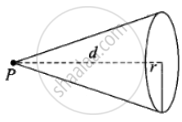
Consider the figure, if P is the power of source then energy received by the atomic disc
`p/(4πd^2) xx pir^2Δt = phi_0`
⇒ Δt = `(4phi_0d^2)/(Pr^2)`
= `(4 xx (2 xx 1.6 xx 10^-19) xx 2^2)/(20 xx (1.5 xx 10^-10)^2`
= 2.84 s
iv. Number of photons received by the atomic disc in time Δt is
N = `(n^' xx pir^2)/(4pid^2) xx Δt`
= `(n^'r^2Δt)/(4d^2)`
= `((5 xx 10^19) xx (1.5 xx 10^-10)^2 xx 28.4)/(4 xx (2)^2`
= 2
Now let us discuss the last part in detail. As the time of emission of electrons is 11.04 s.
v. In photoelectric emission, there is a collision between the incident photon and free electron of the metal surface, which lasts for a very short interval of time (≈ 10–9 s), hence we say photoelectric emission is instantaneous.
APPEARS IN
संबंधित प्रश्न
Every metal has a definite work function. Why do all photoelectrons not come out with the same energy if incident radiation is monochromatic? Why is there an energy distribution of photoelectrons?
Is it always true that for two sources of equal intensity, the number of photons emitted in a given time are equal?
The threshold wavelength of a metal is λ0. Light of wavelength slightly less than λ0 is incident on an insulated plate made of this metal. It is found that photoelectrons are emitted for some time and after that the emission stops. Explain.
Planck's constant has the same dimensions as
A point source of light is used in a photoelectric effect. If the source is removed farther from the emitting metal, the stopping potential
Calculate the momentum of a photon of light of wavelength 500 nm.
(Use h = 6.63 × 10⁻³⁴J-s = 4.14 × 10⁻¹⁵ eV-s, c = 3 × 10⁸ m/s and me = 9.1 × 10⁻³¹kg)
Find the maximum kinetic energy of the photoelectrons ejected when light of wavelength 350 nm is incident on a cesium surface. Work function of cesium = 1.9 eV
(Use h = 6.63 × 10⁻³⁴J-s = 4.14 × 10⁻¹⁵ eV-s, c = 3 × 10⁸ m/s and me = 9.1 × 10⁻³¹kg)
The work function of a photoelectric material is 4.0 eV. (a) What is the threshold wavelength? (b) Find the wavelength of light for which the stopping potential is 2.5 V.
(Use h = 6.63 × 10⁻³⁴J-s = 4.14 × 10⁻¹⁵ eV-s, c = 3 × 10⁸ m/s and me = 9.1 × 10⁻³¹kg)
Define the term: threshold frequency
Read the following paragraph and answer the questions.
| The figure shows the variation of photoelectric current measured in a photocell circuit as a function of the potential difference between the plates of the photocell when light beams A, B, C and D of different wavelengths are incident on the photocell. Examine the given figure and answer the following questions: |

- Which light beam has the highest frequency and why?
- Which light beam has the longest wavelength and why?
- Which light beam ejects photoelectrons with maximum momentum and why?
How would the stopping potential for a given photosensitive surface change if the intensity of incident radiation was decreased? Justify your answer.
A metallic plate exposed to white light emits electrons. For which of the following colours of light, the stopping potential will be maximum?
- Assertion (A): For the radiation of a frequency greater than the threshold frequency, the photoelectric current is proportional to the intensity of the radiation.
- Reason (R): Greater the number of energy quanta available, the greater the number of electrons absorbing the energy quanta and the greater the number of electrons coming out of the metal.
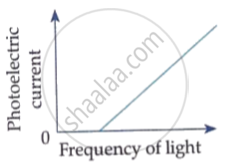
Which of the following options represents the variation of photoelectric current with property of light shown on the x-axis?
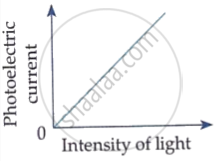
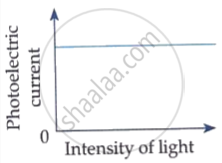
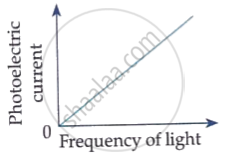
Which theory cannot completely explain important observations of photoelectric emission?
What type of tube contains the plates in the experimental arrangement?
Which apparatus measures photocurrent?
Which radiation does quartz window W especially allow to enter the tube?
After applying a potential difference, how is the resulting photocurrent measured?
