Advertisements
Advertisements
प्रश्न
When the intensity of a light source in increased,
(a) the number of photons emitted by the source in unit time increases
(b) the total energy of the photons emitted per unit time increases
(c) more energetic photons are emitted
(d) faster photons are emitted
Advertisements
उत्तर
(a) the number of photons emitted by the source in unit time increases
(b) the total energy of the photons emitted per unit time increases
When the intensity of a light source in increased, a large number of photons are emitted from the light source. Hence, option (a) is correct.
Due to increase in the number of photons, total energy of the photons emitted per unit time also increases. Hence, option (b) is also correct.
Increase in the intensity of light increases only the number of photons, not the energy of photons, Hence, option (c) is incorrect.
The speed of photons is not affected by the intensity of light, Hence, option (d) is incorrect.
APPEARS IN
संबंधित प्रश्न
Can we find the mass of a photon by the definition p = mv?
If the frequency of light in a photoelectric experiment is doubled, the stopping potential will ______.
A point source of light is used in a photoelectric effect. If the source is removed farther from the emitting metal, the stopping potential
A beam of white light is incident normally on a plane surface absorbing 70% of the light and reflecting the rest. If the incident beam carries 10 W of power, find the force exerted by it on the surface.
(Use h = 6.63 × 10⁻³⁴J-s = 4.14 × 10⁻¹⁵ eV-s, c = 3 × 10⁸ m/s and me = 9.1 × 10⁻³¹kg)
A sphere of radius 1.00 cm is placed in the path of a parallel beam of light of large aperture. The intensity of the light is 0.5 W cm−2. If the sphere completely absorbs the radiation falling on it, Show that the force on the sphere due to the light falling on it is the same even if the sphere is not perfectly absorbing.
Show that it is not possible for a photon to be completely absorbed by a free electron.
The work function of a photoelectric material is 4.0 eV. (a) What is the threshold wavelength? (b) Find the wavelength of light for which the stopping potential is 2.5 V.
(Use h = 6.63 × 10⁻³⁴J-s = 4.14 × 10⁻¹⁵ eV-s, c = 3 × 10⁸ m/s and me = 9.1 × 10⁻³¹kg)
In photoelectric effect, the photoelectric current started to flow. This means that the frequency of incident radiations is ______.
Consider a metal exposed to light of wavelength 600 nm. The maximum energy of the electron doubles when light of wavelength 400 nm is used. Find the work function in eV.
The work function for a metal surface is 4.14 eV. The threshold wavelength for this metal surface is ______.
The graph shows the variation of photocurrent for a photosensitive metal
- What does X and A on the horizontal axis represent?
- Draw this graph for three different values of frequencies of incident radiation ʋ1, ʋ2 and ʋ3 (ʋ3 > ʋ2 > ʋ1) for the same intensity.
- Draw this graph for three different values of intensities of incident radiation I1, I2 and I3 (I3 > I2 > I1) having the same frequency.
Why it is the frequency and not the intensity of the light source that determines whether the emission of photoelectrons will occur or not? Explain.
Read the following paragraph and answer the questions.
| The figure shows the variation of photoelectric current measured in a photocell circuit as a function of the potential difference between the plates of the photocell when light beams A, B, C and D of different wavelengths are incident on the photocell. Examine the given figure and answer the following questions: |

- Which light beam has the highest frequency and why?
- Which light beam has the longest wavelength and why?
- Which light beam ejects photoelectrons with maximum momentum and why?
Which of the following options represents the variation of photoelectric current with property of light shown on the x-axis?
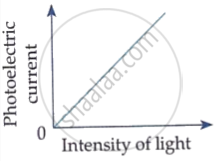
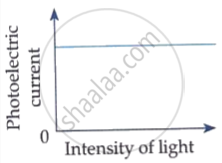
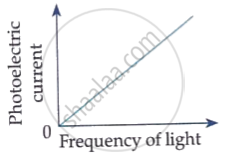
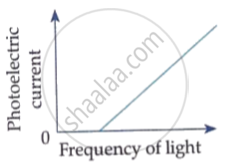
Which theory cannot completely explain important observations of photoelectric emission?
Which plate is kept illuminated by monochromatic radiation?
Between which two parts is a potential difference applied?
For frequencies above the threshold, how does photocurrent change with increasing incident light intensity?
