Advertisements
Advertisements
प्रश्न
Ultraviolet light of wavelength 2271 Å from a 100 W mercury source irradiates a photo-cell made of molybdenum metal. If the stopping potential is −1.3 V, estimate the work function of the metal. How would the photo-cell respond to a high intensity (∼105 W m−2) red light of wavelength 6328 Å produced by a He-Ne laser?
Advertisements
उत्तर
Wavelength of ultraviolet light, λ = 2271 Å = 2271 × 10−10 m
Stopping potential of the metal, V0 = 1.3 V
Planck’s constant, h = 6.6 × 10⁻³⁴ J
Charge on an electron, e = 1.6 × 10⁻¹⁹ C
Work function of the metal = `phi_0`
Frequency of light = v
We have the photo-energy relation from the photoelectric effect as:
`phi_0` = hv − eV0
= `"hc"/lambda - "eV"_0`
= `(6.6 xx 10^(-34) xx 3 xx 10^8)/(2271 xx 10^(-10)) - 1.6 xx 10^(-19) xx 1.3`
= `8.72 xx 10^(-19) - 2.08 xx 10^(-19)`
= `6.64 xx 10^(-19) "J"`
= `(6.64 xx 10^(-19))/(1.6 xx 10^(-19))`
= 4.15 eV
Let v0 be the threshold frequency of the metal.
∴ `phi_0 = "hv"_0`
`"v"_0 = phi_0/"h"`
= `(6.64 xx 10^(-19))/(6.6 xx 10^(-34))`
= 1.006 × 10¹⁵ Hz
Wavelength of red light, `lambda_"r"` = 6328 Å = 6328 × 10−10 m
∴ Frequency of red light, `"v"_"r" = "c"/lambda_"r"`
= `(3 xx 10^8)/(6328 xx 10^(-10))`
= 4.74 × 10¹⁴ Hz
Since v0 > vr, the photocell will not respond to the red light produced by the laser.
APPEARS IN
संबंधित प्रश्न
Should the energy of a photon be called its kinetic energy or its internal energy?
In an experiment on photoelectric effect, a photon is incident on an electron from one direction and the photoelectron is emitted almost in the opposite direction. Does this violate the principle of conservation of momentum?
The equation E = pc is valid
Light of wavelength λ falls on a metal with work-function hc/λ0. Photoelectric effect will take place only if
If the wavelength of light in an experiment on photoelectric effect is doubled,
(a) photoelectric emission will not take place
(b) photoelectric emission may or may not take place
(c) the stopping potential will increase
(d) the stopping potential will decrease
In which of the following situations, the heavier of the two particles has smaller de Broglie wavelength? The two particles
(a) move with the same speed
(b) move with the same linear momentum
(c) move with the same kinetic energy
(d) have fallen through the same height
Calculate the number of photons emitted per second by a 10 W sodium vapour lamp. Assume that 60% of the consumed energy is converted into light. Wavelength of sodium light = 590 nm
(Use h = 6.63 × 10⁻³⁴J-s = 4.14 × 10⁻¹⁵ eV-s, c = 3 × 10⁸ m/s and me = 9.1 × 10⁻³¹kg)
A sphere of radius 1.00 cm is placed in the path of a parallel beam of light of large aperture. The intensity of the light is 0.5 W cm−2. If the sphere completely absorbs the radiation falling on it, find the force exerted by the light beam on the sphere.
(Use h = 6.63 × 10⁻³⁴J-s = 4.14 × 10⁻¹⁵ eV-s, c = 3 × 10⁸ m/s and me = 9.1 × 10⁻³¹kg)
The work function of a photoelectric material is 4.0 eV. (a) What is the threshold wavelength? (b) Find the wavelength of light for which the stopping potential is 2.5 V.
(Use h = 6.63 × 10⁻³⁴J-s = 4.14 × 10⁻¹⁵ eV-s, c = 3 × 10⁸ m/s and me = 9.1 × 10⁻³¹kg)
Find the maximum magnitude of the linear momentum of a photoelectron emitted when a wavelength of 400 nm falls on a metal with work function 2.5 eV.
(Use h = 6.63 × 10⁻³⁴J-s = 4.14 × 10⁻¹⁵ eV-s, c = 3 × 10⁸ m/s and me = 9.1 × 10⁻³¹kg)
The figure is the plot of stopping potential versus the frequency of the light used in an experiment on photoelectric effect. Find (a) the ratio h/e and (b) the work function.
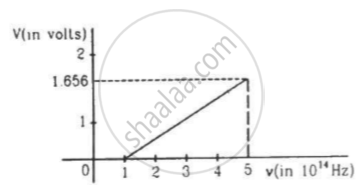
Answer the following question.
Plot a graph of photocurrent versus anode potential for radiation of frequency ν and intensities I1 and I2 (I1 < I2).
Explain how does (i) photoelectric current and (ii) kinetic energy of the photoelectrons emitted in a photocell vary if the frequency of incident radiation is doubled, but keeping the intensity same?
Show the graphical variation in the above two cases.
Which apparatus provides monochromatic radiation for illuminating emitter plate C?
Which apparatus applies a potential difference between the plates?
Which apparatus measures the potential difference?
Which plate is kept illuminated by monochromatic radiation?
When are photoelectrons emitted in relation to the threshold frequency?
