Advertisements
Advertisements
प्रश्न
The electric field associated with a light wave is given by `E = E_0 sin [(1.57 xx 10^7 "m"^-1)(x - ct)]`. Find the stopping potential when this light is used in an experiment on photoelectric effect with the emitter having work function 1.9 eV.
(Use h = 6.63 × 10⁻³⁴J-s = 4.14 × 10⁻¹⁵ eV-s, c = 3 × 10⁸ m/s and me = 9.1 × 10⁻³¹kg)
Advertisements
उत्तर
Given :-
Electric field , `E = E_0 sin [(1.57 xx 10^7 "m"^-1)(x - ct)]`
Work function, `phi = 1.9 "eV"`
On comparing the given equation with the standard equation, `E = E_0 sin (kx - wt)`,
we get :-
`omega = 1.57 xx 10^7 xx c`
Now , frequency,
`v = (1.57 xx 10^7 xx 3 xx 10^8)/(2pi) Hz`
From Einstein's photoelectric equation,
`"eV"_0 = hv - phi`
Here, V0 = stopping potential
e = charge on electron
h = Planck's constant
On substituting the respective values, we get :-
`"eV"_0 = 6.63 xx 10^-34 xx (1.57 xx 3 xx 10^15)/(2pi xx 1.6 xx 10^-19) - 1.9 "eV"`
`⇒ "eV"_0 = 3.105 - 1.9 = 1.205 "eV"`
`⇒ V_0 = (1.205 xx 1.6 xx 10^-19)/(1.6 xx 10^-19) = 1.205 V`
Thus, the value of the stopping potential is 1.205 V.
APPEARS IN
संबंधित प्रश्न
The photoelectric cut-off voltage in a certain experiment is 1.5 V. What is the maximum kinetic energy of photoelectrons emitted?
Should the energy of a photon be called its kinetic energy or its internal energy?
The threshold wavelength of a metal is λ0. Light of wavelength slightly less than λ0 is incident on an insulated plate made of this metal. It is found that photoelectrons are emitted for some time and after that the emission stops. Explain.
If the frequency of light in a photoelectric experiment is doubled, the stopping potential will ______.
A beam of white light is incident normally on a plane surface absorbing 70% of the light and reflecting the rest. If the incident beam carries 10 W of power, find the force exerted by it on the surface.
(Use h = 6.63 × 10⁻³⁴J-s = 4.14 × 10⁻¹⁵ eV-s, c = 3 × 10⁸ m/s and me = 9.1 × 10⁻³¹kg)
The electric field associated with a monochromatic beam is 1.2 × 10¹⁵ times per second. Find the maximum kinetic energy of the photoelectrons when this light falls on a metal surface whose work function is 2.0 eV.
(Use h = 6.63 × 10⁻³⁴J-s = 4.14 × 10⁻¹⁵ eV-s, c = 3 × 10⁸ m/s and me = 9.1 × 10⁻³¹kg)
Define the terms "stopping potential' and 'threshold frequency' in relation to the photoelectric effect. How does one determine these physical quantities using Einstein's equation?
In the case of photoelectric effect experiment, explain the following facts, giving reasons.
The photoelectric current increases with increase of intensity of incident light.
In photoelectric effect the photo current ______.
Do all the electrons that absorb a photon come out as photoelectrons?
The work function for a metal surface is 4.14 eV. The threshold wavelength for this metal surface is ______.
Which of the following options represents the variation of photoelectric current with property of light shown on the x-axis?
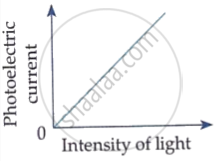
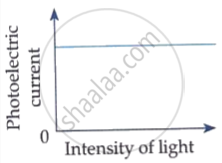
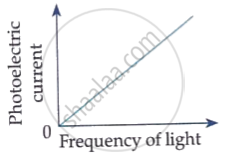
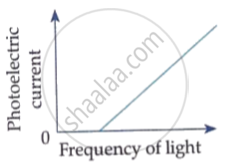
Which theory cannot completely explain important observations of photoelectric emission?
Which part collects electrons emitted from the metal surface?
Which part provides an entry point for incident radiation?
What changes the polarity between the plates?
What type of potential can the battery create between the plates?
Which plate is kept illuminated by monochromatic radiation?
