Advertisements
Advertisements
प्रश्न
A totally reflecting, small plane mirror placed horizontally faces a parallel beam of light, as shown in the figure. The mass of the mirror is 20 g. Assume that there is no absorption in the lens and that 30% of the light emitted by the source goes through the lens. Find the power of the source needed to support the weight of the mirror.
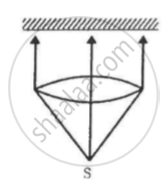
(Use h = 6.63 × 10⁻³⁴J-s = 4.14 × 10⁻¹⁵ eV-s, c = 3 × 10⁸ m/s and me = 9.1 × 10⁻³¹kg)
Advertisements
उत्तर
Given :-
Mass of the mirror, m = 20 g = 20 × 10−3 kg
The weight of the mirror will be balanced if the force exerted by the photons will be equal to the weight of the mirror.
Now,
Relation between wavelength `(λ)` and momentum (p) :-
`p = h/λ`
On divinding both sides by t , we get
`P/t = h/(λt)...............(1)`
Energy,
`E = (hc)/λ`
⇒ `E/t = (hc)/(λt)`
Let P be the power. Then,
`P = E/t = (hc)/(λt)`
`P = (pc)/t ............ ["Using equation (1)"]`
⇒ `P/c = p/t`
Force ,
`F = P/t = P/c ..............("Since F" = ("Momentum")/("Time"))`
Thus, rate of change of momentum = Power/c
As the light gets reflected normally,
Force exerted = 2 (Rate of change of momentum) = 2 × Power/c
`30% "of" ((2 xx "Power")/c) = "mg"`
`⇒ "Power" = (20 xx 10^-3 xx 10 xx 3 xx 10^8 xx 10)/(2 xx 3)= 100" MW"`
APPEARS IN
संबंधित प्रश्न
Ultraviolet light of wavelength 2271 Å from a 100 W mercury source irradiates a photo-cell made of molybdenum metal. If the stopping potential is −1.3 V, estimate the work function of the metal. How would the photo-cell respond to a high intensity (∼105 W m−2) red light of wavelength 6328 Å produced by a He-Ne laser?
If an electron has a wavelength, does it also have a colour?
Planck's constant has the same dimensions as
Let nr and nb be the number of photons emitted by a red bulb and a blue bulb, respectively, of equal power in a given time.
If the frequency of light in a photoelectric experiment is doubled, the stopping potential will ______.
Calculate the number of photons emitted per second by a 10 W sodium vapour lamp. Assume that 60% of the consumed energy is converted into light. Wavelength of sodium light = 590 nm
(Use h = 6.63 × 10⁻³⁴J-s = 4.14 × 10⁻¹⁵ eV-s, c = 3 × 10⁸ m/s and me = 9.1 × 10⁻³¹kg)
A sphere of radius 1.00 cm is placed in the path of a parallel beam of light of large aperture. The intensity of the light is 0.5 W cm−2. If the sphere completely absorbs the radiation falling on it, Show that the force on the sphere due to the light falling on it is the same even if the sphere is not perfectly absorbing.
The electric field associated with a monochromatic beam is 1.2 × 10¹⁵ times per second. Find the maximum kinetic energy of the photoelectrons when this light falls on a metal surface whose work function is 2.0 eV.
(Use h = 6.63 × 10⁻³⁴J-s = 4.14 × 10⁻¹⁵ eV-s, c = 3 × 10⁸ m/s and me = 9.1 × 10⁻³¹kg)
In the case of photoelectric effect experiment, explain the following facts, giving reasons.
The photoelectric current increases with increase of intensity of incident light.
Do all the electrons that absorb a photon come out as photoelectrons?
How would the stopping potential for a given photosensitive surface change if the intensity of incident radiation was decreased? Justify your answer.
How would the stopping potential for a given photosensitive surface change if the frequency of the incident radiation were increased? Justify your answer.
A metallic plate exposed to white light emits electrons. For which of the following colours of light, the stopping potential will be maximum?
What is studied when light falls on a metal surface?
Which theory cannot completely explain important observations of photoelectric emission?
What is noted when light intensity is changed?
For frequencies above the threshold, how does photocurrent change with increasing incident light intensity?
How quickly does photoelectric emission occur when suitable radiation falls on the metal surface?
