Advertisements
Advertisements
Question
A totally reflecting, small plane mirror placed horizontally faces a parallel beam of light, as shown in the figure. The mass of the mirror is 20 g. Assume that there is no absorption in the lens and that 30% of the light emitted by the source goes through the lens. Find the power of the source needed to support the weight of the mirror.
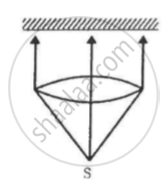
(Use h = 6.63 × 10⁻³⁴J-s = 4.14 × 10⁻¹⁵ eV-s, c = 3 × 10⁸ m/s and me = 9.1 × 10⁻³¹kg)
Advertisements
Solution
Given :-
Mass of the mirror, m = 20 g = 20 × 10−3 kg
The weight of the mirror will be balanced if the force exerted by the photons will be equal to the weight of the mirror.
Now,
Relation between wavelength `(λ)` and momentum (p) :-
`p = h/λ`
On divinding both sides by t , we get
`P/t = h/(λt)...............(1)`
Energy,
`E = (hc)/λ`
⇒ `E/t = (hc)/(λt)`
Let P be the power. Then,
`P = E/t = (hc)/(λt)`
`P = (pc)/t ............ ["Using equation (1)"]`
⇒ `P/c = p/t`
Force ,
`F = P/t = P/c ..............("Since F" = ("Momentum")/("Time"))`
Thus, rate of change of momentum = Power/c
As the light gets reflected normally,
Force exerted = 2 (Rate of change of momentum) = 2 × Power/c
`30% "of" ((2 xx "Power")/c) = "mg"`
`⇒ "Power" = (20 xx 10^-3 xx 10 xx 3 xx 10^8 xx 10)/(2 xx 3)= 100" MW"`
APPEARS IN
RELATED QUESTIONS
Use the same formula you employ in (a) to obtain electron speed for an collector potential of 10 MV. Do you see what is wrong? In what way is the formula to be modified?
The work function for the following metals is given:
Na: 2.75 eV; K: 2.30 eV; Mo: 4.17 eV; Ni: 5.15 eV
Which of these metals will not give photoelectric emission for a radiation of wavelength 3300 Å from a He-Cd laser placed 1 m away from the photocell? What happens if the laser is brought nearer and placed 50 cm away?
The following graph shows the variation of photocurrent for a photosensitive metal :
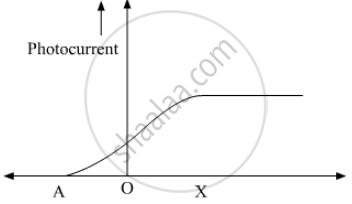
(a) Identify the variable X on the horizontal axis.
(b) What does the point A on the horizontal axis represent?
(c) Draw this graph for three different values of frequencies of incident radiation v1, v2 and v3 (v1 > v2 > v3) for same intensity.
(d) Draw this graph for three different values of intensities of incident radiation I1, I2 and I3 (I1 > I2 > I3) having same frequency.
Is it always true that for two sources of equal intensity, the number of photons emitted in a given time are equal?
Should the energy of a photon be called its kinetic energy or its internal energy?
In an experiment on photoelectric effect, a photon is incident on an electron from one direction and the photoelectron is emitted almost in the opposite direction. Does this violate the principle of conservation of momentum?
The work function of a metal is hv0. Light of frequency v falls on this metal. Photoelectric effect will take place only if
A point source causes photoelectric effect from a small metal plate. Which of the following curves may represent the saturation photocurrent as a function of the distance between the source and the metal?
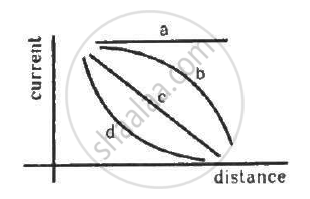
Photoelectric effect supports quantum nature of light because
(a) there is a minimum frequency below which no photoelectrons are emitted
(b) the maximum kinetic energy of photoelectrons depends only on the frequency of light and not on its intensity
(c) even when the metal surface is faintly illuminated the photoelectrons leave the surface immediately
(d) electric charge of the photoelectrons is quantised
A parallel beam of monochromatic light of wavelength 663 nm is incident on a totally reflecting plane mirror. The angle of incidence is 60° and the number of photons striking the mirror per second is 1.0 × 10¹⁹. Calculate the force exerted by the light beam on the mirror.
(Use h = 6.63 × 10⁻³⁴J-s = 4.14 × 10⁻¹⁵ eV-s, c = 3 × 10⁸ m/s and me = 9.1 × 10⁻³¹kg)
The work function of a photoelectric material is 4.0 eV. (a) What is the threshold wavelength? (b) Find the wavelength of light for which the stopping potential is 2.5 V.
(Use h = 6.63 × 10⁻³⁴J-s = 4.14 × 10⁻¹⁵ eV-s, c = 3 × 10⁸ m/s and me = 9.1 × 10⁻³¹kg)
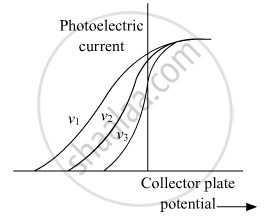
On the basis of the graphs shown in the figure, answer the following questions :
(a) Which physical parameter is kept constant for the three curves?
(b) Which is the highest frequency among v1, v2, and v3?
The work function for a metal surface is 4.14 eV. The threshold wavelength for this metal surface is ______.
The graph shows the variation of photocurrent for a photosensitive metal
- What does X and A on the horizontal axis represent?
- Draw this graph for three different values of frequencies of incident radiation ʋ1, ʋ2 and ʋ3 (ʋ3 > ʋ2 > ʋ1) for the same intensity.
- Draw this graph for three different values of intensities of incident radiation I1, I2 and I3 (I3 > I2 > I1) having the same frequency.
The figure shows a plot of stopping potential (V0) versus `1/lambda`, where λ is the wavelength of the radiation causing photoelectric emission from a surface. The slope of the line is equal to ______.

A metallic plate exposed to white light emits electrons. For which of the following colours of light, the stopping potential will be maximum?
Which part is the photosensitive metal plate?
What changes the polarity between the plates?
Between which two parts is a potential difference applied?
After applying a potential difference, how is the resulting photocurrent measured?
