Advertisements
Advertisements
Question
What is the speed of a photon with respect to another photon if (a) the two photons are going in the same direction and (b) they are going in opposite directions?
Advertisements
Solution
(a) In relativity, the relative speed of two objects `(v_(rel))` moving in the same direction with speeds u and v is given by `v_(rel) = (u - v)/(1-(uv)/c^2)` ...(1)
As the photons are moving with the speed of light, u = c and v = c.
On substituting the values of u and v in equation (1), we get :
`v_(rel) = 0`
Thus, relative velocity of a photon with respect to another photon will be 0, when they are going in the same direction.
(b) In relativity, relative speed of two objects moving in opposite directions with speeds u and v is given by
`v_(rel) = (u+v)/(1+(uv)/c^2)` ....(2)
We know that a photon travels with the speed of light. Therefore, u = c and v = c
On substituting the values of u and v in equation (2), we get :
`v_(rel) = c`
Thus, the relative velocity of a photon with respect to another photon will be equal to the speed of light when they are going in opposite directions.
APPEARS IN
RELATED QUESTIONS
Use the same formula you employ in (a) to obtain electron speed for an collector potential of 10 MV. Do you see what is wrong? In what way is the formula to be modified?
The work function for the following metals is given:
Na: 2.75 eV; K: 2.30 eV; Mo: 4.17 eV; Ni: 5.15 eV
Which of these metals will not give photoelectric emission for a radiation of wavelength 3300 Å from a He-Cd laser placed 1 m away from the photocell? What happens if the laser is brought nearer and placed 50 cm away?
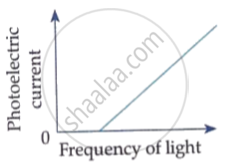
The following graph shows the variation of photocurrent for a photosensitive metal :
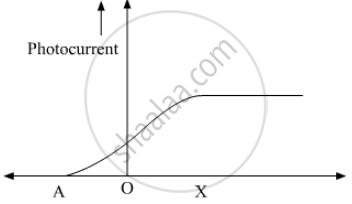
(a) Identify the variable X on the horizontal axis.
(b) What does the point A on the horizontal axis represent?
(c) Draw this graph for three different values of frequencies of incident radiation v1, v2 and v3 (v1 > v2 > v3) for same intensity.
(d) Draw this graph for three different values of intensities of incident radiation I1, I2 and I3 (I1 > I2 > I3) having same frequency.
It is found that yellow light does not eject photoelectrons from a metal. Is it advisable to try with orange light or with green light?
The equation E = pc is valid
The work function of a metal is hv0. Light of frequency v falls on this metal. Photoelectric effect will take place only if
When the sun is directly overhead, the surface of the earth receives 1.4 × 10³ W m−2 of sunlight. Assume that the light is monochromatic with average wavelength 500 nm and that no light is absorbed in between the sun and the earth's surface. The distance between the sun and the earth is 1.5 × 10¹¹ m. (a) Calculate the number of photons falling per second on each square metre of earth's surface directly below the sun. (b) How many photons are there in each cubic metre near the earth's surface at any instant? (c) How many photons does the sun emit per second?
(Use h = 6.63 × 10⁻³⁴J-s = 4.14 × 10⁻¹⁵ eV-s, c = 3 × 10⁸ m/s and me = 9.1 × 10⁻³¹kg)
Find the maximum magnitude of the linear momentum of a photoelectron emitted when a wavelength of 400 nm falls on a metal with work function 2.5 eV.
(Use h = 6.63 × 10⁻³⁴J-s = 4.14 × 10⁻¹⁵ eV-s, c = 3 × 10⁸ m/s and me = 9.1 × 10⁻³¹kg)
In an experiment on photoelectric effect, the stopping potential is measured for monochromatic light beams corresponding to different wavelengths. The data collected are as follows:-
Wavelength (nm): 350 400 450 500 550
Stopping potential (V): 1.45 1.00 0.66 0.38 0.16
Plot the stopping potential against inverse of wavelength (1/λ) on a graph paper and find (a) Planck's constant (b) the work function of the emitter and (c) the threshold wavelength.
(Use h = 6.63 × 10⁻³⁴J-s = 4.14 × 10⁻¹⁵ eV-s, c = 3 × 10⁸ m/s and me = 9.1 × 10⁻³¹kg)
Consider a metal exposed to light of wavelength 600 nm. The maximum energy of the electron doubles when light of wavelength 400 nm is used. Find the work function in eV.
How would the stopping potential for a given photosensitive surface change if the frequency of the incident radiation were increased? Justify your answer.
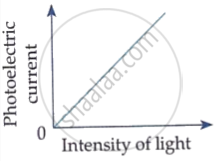
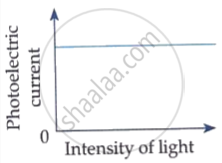
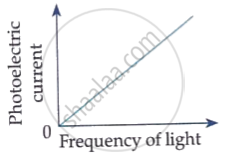
Which of the following options represents the variation of photoelectric current with property of light shown on the x-axis?
The difference between threshold wavelengths for two metal surfaces A and B having work function ΦA = 9 eV and ΦB = 4.5 eV in nm is ______.
(Given, hc = 1242 eV nm)
Which theory cannot completely explain important observations of photoelectric emission?
Which part collects electrons emitted from the metal surface?
Which part provides an entry point for incident radiation?
Which apparatus measures the potential difference?
When are photoelectrons emitted in relation to the threshold frequency?
