Advertisements
Advertisements
Question
What is the effect of threshold frequency and stopping potential on increasing the frequency of the incident beam of light? Justify your answer.
Advertisements
Solution
Threshold frequency: The threshold frequency is the lowest frequency of incident radiation that can cause an electron to be ejected from a metal. At frequencies below the threshold, there is no photoelectric emission.
The frequency of light that will produce an emission of electrons from the metal's surface is referred to as the threshold frequency.
If ν signifies the frequency of the incident photon and νth signifies threshold frequency, then;
- If ν < νth, then this denotes that no ejection of photoelectrons will occur.
- If ν = νth, then this denotes that photoelectrons are just ejected from the surface of the metal, however, the kinetic energy of the electron is equal to zero.
The minimal negative voltage that must be provided to the anode to halt the photocurrent is known as stopping potential. When expressed in electron volts, the stopping voltage corresponds to the electrons' maximum kinetic energy.
Stopping potential, `eV_0 = hν_"incident" - phi`
Where ν is the frequency of the incident radiation and Φ is the metal surface's work function. As a result, stopping potential rises as incident radiation frequency rises.
APPEARS IN
RELATED QUESTIONS
Light of intensity 10−5 W m−2 falls on a sodium photo-cell of surface area 2 cm2. Assuming that the top 5 layers of sodium absorb the incident energy, estimate time required for photoelectric emission in the wave-picture of radiation. The work function for the metal is given to be about 2 eV. What is the implication of your answer?
Is it always true that for two sources of equal intensity, the number of photons emitted in a given time are equal?
It is found that photosynthesis starts in certain plants when exposed to sunlight, but it does not start if the plants are exposed only to infrared light. Explain.
Light of wavelength λ falls on a metal with work-function hc/λ0. Photoelectric effect will take place only if
If the frequency of light in a photoelectric experiment is doubled, the stopping potential will ______.
Calculate the number of photons emitted per second by a 10 W sodium vapour lamp. Assume that 60% of the consumed energy is converted into light. Wavelength of sodium light = 590 nm
(Use h = 6.63 × 10⁻³⁴J-s = 4.14 × 10⁻¹⁵ eV-s, c = 3 × 10⁸ m/s and me = 9.1 × 10⁻³¹kg)
The electric field associated with a light wave is given by `E = E_0 sin [(1.57 xx 10^7 "m"^-1)(x - ct)]`. Find the stopping potential when this light is used in an experiment on photoelectric effect with the emitter having work function 1.9 eV.
(Use h = 6.63 × 10⁻³⁴J-s = 4.14 × 10⁻¹⁵ eV-s, c = 3 × 10⁸ m/s and me = 9.1 × 10⁻³¹kg)
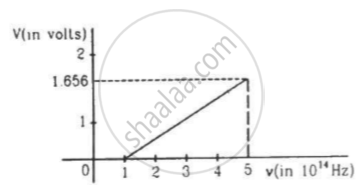
The figure is the plot of stopping potential versus the frequency of the light used in an experiment on photoelectric effect. Find (a) the ratio h/e and (b) the work function.
If photons of ultraviolet light of energy 12 eV are incident on a metal surface of work function of 4 eV, then the stopping potential (in eV) will be :
How would the stopping potential for a given photosensitive surface change if the intensity of incident radiation was decreased? Justify your answer.
