Advertisements
Advertisements
प्रश्न
What is the effect of threshold frequency and stopping potential on increasing the frequency of the incident beam of light? Justify your answer.
Advertisements
उत्तर
Threshold frequency: The threshold frequency is the lowest frequency of incident radiation that can cause an electron to be ejected from a metal. At frequencies below the threshold, there is no photoelectric emission.
The frequency of light that will produce an emission of electrons from the metal's surface is referred to as the threshold frequency.
If ν signifies the frequency of the incident photon and νth signifies threshold frequency, then;
- If ν < νth, then this denotes that no ejection of photoelectrons will occur.
- If ν = νth, then this denotes that photoelectrons are just ejected from the surface of the metal, however, the kinetic energy of the electron is equal to zero.
The minimal negative voltage that must be provided to the anode to halt the photocurrent is known as stopping potential. When expressed in electron volts, the stopping voltage corresponds to the electrons' maximum kinetic energy.
Stopping potential, `eV_0 = hν_"incident" - phi`
Where ν is the frequency of the incident radiation and Φ is the metal surface's work function. As a result, stopping potential rises as incident radiation frequency rises.
APPEARS IN
संबंधित प्रश्न
(a) Estimate the speed with which electrons emitted from a heated emitter of an evacuated tube impinge on the collector maintained at a potential difference of 500 V with respect to the emitter. Ignore the small initial speeds of the electrons. The specific charge of the electron, i.e., its e/m is given to be 1.76 × 10¹¹ C kg−1.
(b) Use the same formula you employ in (a) to obtain electron speed for an collector potential of 10 MV. Do you see what is wrong? In what way is the formula to be modified?
It is found that yellow light does not eject photoelectrons from a metal. Is it advisable to try with orange light or with green light?
Let nr and nb be the number of photons emitted by a red bulb and a blue bulb, respectively, of equal power in a given time.
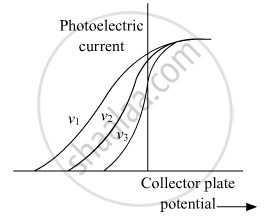
On the basis of the graphs shown in the figure, answer the following questions :
(a) Which physical parameter is kept constant for the three curves?
(b) Which is the highest frequency among v1, v2, and v3?
Plot a graph showing the variation of photoelectric current, as a function of anode potential for two light beams having the same frequency but different intensities I1 and I2 (I1 > I2). Mention its important features.
Which theory cannot completely explain important observations of photoelectric emission?
How does collector plate A help measure current?
Which plate is kept illuminated by monochromatic radiation?
After applying a potential difference, how is the resulting photocurrent measured?
What is used to change light frequency and study its effect on emission and electron energy?
