Advertisements
Advertisements
प्रश्न
How would the stopping potential for a given photosensitive surface change if the frequency of the incident radiation were increased? Justify your answer.
Advertisements
उत्तर
The stopping potential for a certain photosensitive surface increases as the frequency of the incident radiation increases. This is because the stopping potential is directly proportional to the frequency of the incident radiation, according to the photoelectric effect equation: Kmax = hf - Φ, where h is Planck's constant, f is the frequency of incident radiation and the metal's work function. Kmax is the photoelectron's maximal kinetic energy. As a result, as the frequency of the input radiation increases, so does the stopping potential required to stop the photoelectrons, while the kinetic energy of the photoelectrons emitted decreases.
APPEARS IN
संबंधित प्रश्न
Define the term 'intensity of radiation' in terms of photon picture of light.
Every metal has a definite work function. Why do all photoelectrons not come out with the same energy if incident radiation is monochromatic? Why is there an energy distribution of photoelectrons?
The following graph shows the variation of photocurrent for a photosensitive metal :
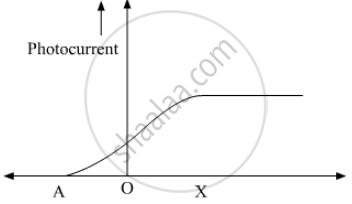
(a) Identify the variable X on the horizontal axis.
(b) What does the point A on the horizontal axis represent?
(c) Draw this graph for three different values of frequencies of incident radiation v1, v2 and v3 (v1 > v2 > v3) for same intensity.
(d) Draw this graph for three different values of intensities of incident radiation I1, I2 and I3 (I1 > I2 > I3) having same frequency.
In an experiment on photoelectric effect, a photon is incident on an electron from one direction and the photoelectron is emitted almost in the opposite direction. Does this violate the principle of conservation of momentum?
A totally reflecting, small plane mirror placed horizontally faces a parallel beam of light, as shown in the figure. The mass of the mirror is 20 g. Assume that there is no absorption in the lens and that 30% of the light emitted by the source goes through the lens. Find the power of the source needed to support the weight of the mirror.
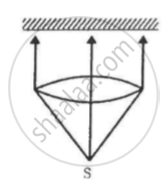
(Use h = 6.63 × 10⁻³⁴J-s = 4.14 × 10⁻¹⁵ eV-s, c = 3 × 10⁸ m/s and me = 9.1 × 10⁻³¹kg)
Consider a metal exposed to light of wavelength 600 nm. The maximum energy of the electron doubles when light of wavelength 400 nm is used. Find the work function in eV.
Why it is the frequency and not the intensity of the light source that determines whether the emission of photoelectrons will occur or not? Explain.
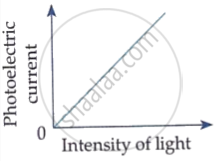
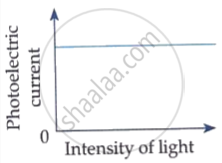
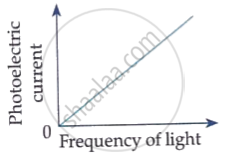
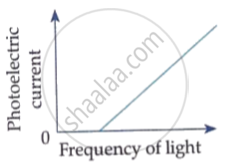
Which of the following options represents the variation of photoelectric current with property of light shown on the x-axis?
Which radiation does quartz window W especially allow to enter the tube?
After applying a potential difference, how is the resulting photocurrent measured?
