Advertisements
Advertisements
प्रश्न
Consider a thin target (10–2 cm square, 10–3 m thickness) of sodium, which produces a photocurrent of 100 µA when a light of intensity 100W/m2 (λ = 660 nm) falls on it. Find the probability that a photoelectron is produced when a photons strikes a sodium atom. [Take density of Na = 0.97 kg/m3].
Advertisements
उत्तर
According to the problem, the area of the target A = 10–2 cm2 = 10–4 m2
And thickness, d = 10–3 m
Photocurrent, i = 100 × 10–6 A= 10–4 A
Intensity, I = 100 W/m2
⇒ λ = 660 nm = 660 × 10–9 m
ρNa = 0.97 kg/m3
Avogadro number = 6 × 1026 kg atom
Volume of sodium target = A × d
= 10–4 × 10–3
= 10–7 m3
We know that 6 × 1026 atoms of sodium weigh = 23 kg
Density of sodium = 0.97 kg/m3
Hence the volume of 6 × 1026 sodium atoms = `23/0.97` m3
Volume occupied by one sodium atom = `23/(0.97 xx (6 xx 10^36))` = 3.95 × 10⁻²⁶ m3
Number of sodium atoms in target `(N_"sodium") = 10^-7/(3.95 xx 10^-26)` = 2.53 × 10¹⁸
Let m be the number of photons falling per second on the target.
Energy of each photon = `(hc)/A`
Total energy falling per second on target = `(nhc)/λ = IA`
∴ `n = (IAλ)/(hc)`
= `(100 xx 10^-4 xx (660 xx 10^-9))/((6.62 xx 10^-34) xx (3 xx 10^8))` = 3.3 × 10¹⁶
Let P be the probability of emission per atom per photon. The number of photoelectrons emitted per second
`N = P xx n xx (N_"sodium")`
= `P xx (33 xx 10^16) xx (2.53 xx 10^18)`
Now, according to the question,
i = 100 µA = 100 × 10–6 = 10–4 A
Current, i = Ne
∴ `10^-4 xx P xx (3.3 xx 10^16) xx (2.53 xx 10^18) xx (1.6 xx 10^-19)`
⇒ `P = 10^-4/((3.3 xx 10^16) xx (2.53 xx 10^18) xx (1.6 xx 10^-19))`
= 7.48 × 10⁻²¹
Then, the probability of photoemission by a single photon on a single atom is very much less than 1. Because the absorption of two photons by an atom is negligible.
APPEARS IN
संबंधित प्रश्न
Use the same formula you employ in (a) to obtain electron speed for an collector potential of 10 MV. Do you see what is wrong? In what way is the formula to be modified?
Monochromatic radiation of wavelength 640.2 nm (1 nm = 10−9 m) from a neon lamp irradiates photosensitive material made of caesium on tungsten. The stopping voltage is measured to be 0.54 V. The source is replaced by an iron source and its 427.2 nm line irradiates the same photo-cell. Predict the new stopping voltage.
Every metal has a definite work function. Why do all photoelectrons not come out with the same energy if incident radiation is monochromatic? Why is there an energy distribution of photoelectrons?
The following graph shows the variation of photocurrent for a photosensitive metal :
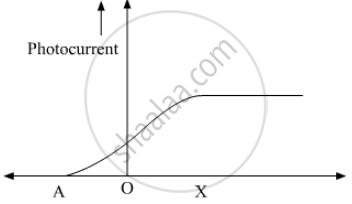
(a) Identify the variable X on the horizontal axis.
(b) What does the point A on the horizontal axis represent?
(c) Draw this graph for three different values of frequencies of incident radiation v1, v2 and v3 (v1 > v2 > v3) for same intensity.
(d) Draw this graph for three different values of intensities of incident radiation I1, I2 and I3 (I1 > I2 > I3) having same frequency.
Should the energy of a photon be called its kinetic energy or its internal energy?
It is found that yellow light does not eject photoelectrons from a metal. Is it advisable to try with orange light or with green light?
It is found that photosynthesis starts in certain plants when exposed to sunlight, but it does not start if the plants are exposed only to infrared light. Explain.
The equation E = pc is valid
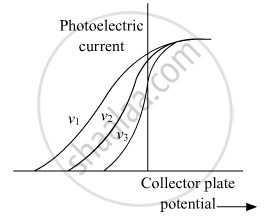
On the basis of the graphs shown in the figure, answer the following questions :
(a) Which physical parameter is kept constant for the three curves?
(b) Which is the highest frequency among v1, v2, and v3?
Define the term: stopping potential in the photoelectric effect.
Two monochromatic beams A and B of equal intensity I, hit a screen. The number of photons hitting the screen by beam A is twice that by beam B. Then what inference can you make about their frequencies?
How would the stopping potential for a given photosensitive surface change if the frequency of the incident radiation were increased? Justify your answer.
A metallic plate exposed to white light emits electrons. For which of the following colours of light, the stopping potential will be maximum?
The difference between threshold wavelengths for two metal surfaces A and B having work function ΦA = 9 eV and ΦB = 4.5 eV in nm is ______.
(Given, hc = 1242 eV nm)
Which part collects electrons emitted from the metal surface?
Which apparatus measures the potential difference?
For frequencies above the threshold, how does photocurrent change with increasing incident light intensity?
Why does greater light intensity produce more emitted electrons?
What happens if the frequency of incident radiation is below the threshold frequency?
