Advertisements
Advertisements
प्रश्न
A photon of energy hv is absorbed by a free electron of a metal with work-function hv − φ.
विकल्प
The electron is sure to come out.
The electron is sure to come out with kinetic energy hv − φ.
Either the electron does not come out or it comes our with kinetic energy hv − φ.
It may come out with kinetic energy less than hv − φ.
Advertisements
उत्तर
It may come out with kinetic energy less than hv − φ.
When light is incident on the metal surface, the photons of light collide with the free electrons. In some cases, a photon can give all the energy to the free electron. If this energy is more then the work-function of the metal,then there are two possibilities. The electron can come out of the metal with kinetic energy hv − φ or it may lose energy on collision with the atoms of the metal and come out with kinetic energy less than hv − φ. Thus, it may come out with kinetic energy less than hv − φ.
APPEARS IN
संबंधित प्रश्न
Is it always true that for two sources of equal intensity, the number of photons emitted in a given time are equal?
A hot body is placed in a closed room maintained at a lower temperature. Is the number of photons in the room increasing?
In an experiment on photoelectric effect, a photon is incident on an electron from one direction and the photoelectron is emitted almost in the opposite direction. Does this violate the principle of conservation of momentum?
It is found that photosynthesis starts in certain plants when exposed to sunlight, but it does not start if the plants are exposed only to infrared light. Explain.
Planck's constant has the same dimensions as
A point source of light is used in a photoelectric effect. If the source is removed farther from the emitting metal, the stopping potential
When the sun is directly overhead, the surface of the earth receives 1.4 × 10³ W m−2 of sunlight. Assume that the light is monochromatic with average wavelength 500 nm and that no light is absorbed in between the sun and the earth's surface. The distance between the sun and the earth is 1.5 × 10¹¹ m. (a) Calculate the number of photons falling per second on each square metre of earth's surface directly below the sun. (b) How many photons are there in each cubic metre near the earth's surface at any instant? (c) How many photons does the sun emit per second?
(Use h = 6.63 × 10⁻³⁴J-s = 4.14 × 10⁻¹⁵ eV-s, c = 3 × 10⁸ m/s and me = 9.1 × 10⁻³¹kg)
A beam of white light is incident normally on a plane surface absorbing 70% of the light and reflecting the rest. If the incident beam carries 10 W of power, find the force exerted by it on the surface.
(Use h = 6.63 × 10⁻³⁴J-s = 4.14 × 10⁻¹⁵ eV-s, c = 3 × 10⁸ m/s and me = 9.1 × 10⁻³¹kg)
When a metal plate is exposed to a monochromatic beam of light of wavelength 400 nm, a negative potential of 1.1 V is needed to stop the photo current. Find the threshold wavelength for the metal.
(Use h = 6.63 × 10⁻³⁴J-s = 4.14 × 10⁻¹⁵ eV-s, c = 3 × 10⁸ m/s and me = 9.1 × 10⁻³¹kg)
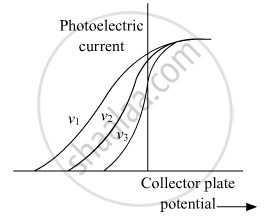
On the basis of the graphs shown in the figure, answer the following questions :
(a) Which physical parameter is kept constant for the three curves?
(b) Which is the highest frequency among v1, v2, and v3?
In photoelectric effect, the photoelectric current started to flow. This means that the frequency of incident radiations is ______.
Consider a 20 W bulb emitting light of wavelength 5000 Å and shining on a metal surface kept at a distance 2 m. Assume that the metal surface has work function of 2 eV and that each atom on the metal surface can be treated as a circular disk of radius 1.5 Å.
- Estimate no. of photons emitted by the bulb per second. [Assume no other losses]
- Will there be photoelectric emission?
- How much time would be required by the atomic disk to receive energy equal to work function (2 eV)?
- How many photons would atomic disk receive within time duration calculated in (iii) above?
- Can you explain how photoelectric effect was observed instantaneously?
The graph shows the variation of photocurrent for a photosensitive metal
- What does X and A on the horizontal axis represent?
- Draw this graph for three different values of frequencies of incident radiation ʋ1, ʋ2 and ʋ3 (ʋ3 > ʋ2 > ʋ1) for the same intensity.
- Draw this graph for three different values of intensities of incident radiation I1, I2 and I3 (I3 > I2 > I1) having the same frequency.
How would the stopping potential for a given photosensitive surface change if the intensity of incident radiation was decreased? Justify your answer.
Which three factors are varied to examine how photocurrent behaves?
How does collector plate A help measure current?
Why is the polarity reversed during the procedure?
Why does greater light intensity produce more emitted electrons?
Which observation was one of the major difficulties for classical wave theory?
