Advertisements
Advertisements
प्रश्न
When the sun is directly overhead, the surface of the earth receives 1.4 × 10³ W m−2 of sunlight. Assume that the light is monochromatic with average wavelength 500 nm and that no light is absorbed in between the sun and the earth's surface. The distance between the sun and the earth is 1.5 × 10¹¹ m. (a) Calculate the number of photons falling per second on each square metre of earth's surface directly below the sun. (b) How many photons are there in each cubic metre near the earth's surface at any instant? (c) How many photons does the sun emit per second?
(Use h = 6.63 × 10⁻³⁴J-s = 4.14 × 10⁻¹⁵ eV-s, c = 3 × 10⁸ m/s and me = 9.1 × 10⁻³¹kg)
Advertisements
उत्तर
Here,
Intensity of light, `l = 1.4 × 10^3` W/m2,
Wavelength of light, `λ = 500 "nm" = 500 xx 10^-9 "m"`
Distance between the Sun and Earth, `l = 1.5 xx 10^11 "m"`
Intensity,
`I = "power"/"Area" = 1.4 xx 10^3 "W/m"^2`
Let n be the number of photons emitted per second.
∴ Power, P = Energy emitted/second
`P = (nhc)/λ`,
where λ = wavelength of light
h = Planck's constant
c = speed of light
Number of photons/`"m"^2` = `(nhc)/(λ xx A) = (nhc)/(λ xx 1) = l`
`therefore n = (I xx λ)/(hc)`
= `(1.4 xx 10^3 xx 500 xx 10^-9)/(6.63 xx 10^-34 xx 3 xx 10^8)`
= `3.5 xx 10^21`
(b) Consider number of two parts at a distance r and r + dr from the source.
Let dt' be the time interval in which the photon travels from one part to another.
Total number of photons emitted in this time interval,
`N = ndt = ((Pλ)/(hc xx A))(dr)/c`
These points will be between two spherical shells of radius 'r' and r + dr. It will be the distance of the 1st point from the sources.
In this case,
`l = 1.5 xx 10^11 "m"`
`"Wavelength" , λ = 500 "nm" = 500 xx 10^-9 "m"`
`P/(4pir^2) = 1.4 xx 10^3`
∴ No. of photons `/"m"^3 = P/(4pir^2) λ/(hc^2)`
= `1.4 xx 10^3 xx (500 xx 10^-9)/(6.63 xx 10^-34 xx 9 xx 10^16`
= `1.2 xx 10^13`
(c) Number of photons emitted = (Number of photons / s-m2) × Area
= `(3.5 xx 10^21) xx 4pil^2`
= `3.5 xx 10^21 xx 4 xx (3.14) xx (1.5 xx 10^11)^2`
= `9.9 xx 10^44`
APPEARS IN
संबंधित प्रश्न
The photoelectric cut-off voltage in a certain experiment is 1.5 V. What is the maximum kinetic energy of photoelectrons emitted?
The work function for the following metals is given:
Na: 2.75 eV; K: 2.30 eV; Mo: 4.17 eV; Ni: 5.15 eV
Which of these metals will not give photoelectric emission for a radiation of wavelength 3300 Å from a He-Cd laser placed 1 m away from the photocell? What happens if the laser is brought nearer and placed 50 cm away?
Two photons of
Show that it is not possible for a photon to be completely absorbed by a free electron.
The electric field associated with a monochromatic beam is 1.2 × 10¹⁵ times per second. Find the maximum kinetic energy of the photoelectrons when this light falls on a metal surface whose work function is 2.0 eV.
(Use h = 6.63 × 10⁻³⁴J-s = 4.14 × 10⁻¹⁵ eV-s, c = 3 × 10⁸ m/s and me = 9.1 × 10⁻³¹kg)
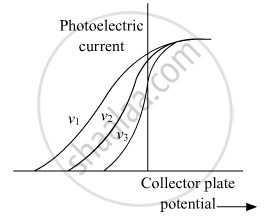
On the basis of the graphs shown in the figure, answer the following questions :
(a) Which physical parameter is kept constant for the three curves?
(b) Which is the highest frequency among v1, v2, and v3?
Define the term: stopping potential in the photoelectric effect.
The graph shows the variation of photocurrent for a photosensitive metal
- What does X and A on the horizontal axis represent?
- Draw this graph for three different values of frequencies of incident radiation ʋ1, ʋ2 and ʋ3 (ʋ3 > ʋ2 > ʋ1) for the same intensity.
- Draw this graph for three different values of intensities of incident radiation I1, I2 and I3 (I3 > I2 > I1) having the same frequency.
Plot a graph showing the variation of photoelectric current, as a function of anode potential for two light beams having the same frequency but different intensities I1 and I2 (I1 > I2). Mention its important features.
A metallic plate exposed to white light emits electrons. For which of the following colours of light, the stopping potential will be maximum?
What is the effect of threshold frequency and stopping potential on increasing the frequency of the incident beam of light? Justify your answer.
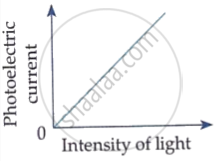
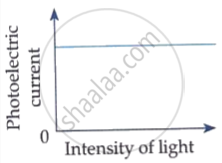
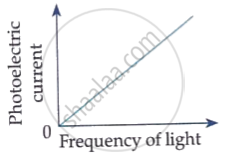
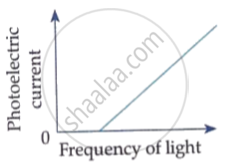
Which of the following options represents the variation of photoelectric current with property of light shown on the x-axis?
What is studied when light falls on a metal surface?
Which part is the photosensitive metal plate?
Which apparatus applies a potential difference between the plates?
Which apparatus measures photocurrent?
What is noted when light intensity is changed?
What is used to change light frequency and study its effect on emission and electron energy?
What happens when the collector is made negative with respect to the emitter?
How quickly does photoelectric emission occur when suitable radiation falls on the metal surface?
