Advertisements
Advertisements
प्रश्न
If the frequency of light in a photoelectric experiment is doubled, the stopping potential will ______.
विकल्प
be doubled
be halved
become more than double
become less than double
Advertisements
उत्तर
If the frequency of light in a photoelectric experiment is doubled, the stopping potential will become more than double.
Explanation:
According to Einstein's equation of the photoelectric effect,
`eV_0 = hv - varphi`
⇒ `V_0 = (hv - varphi)/e` ....(1)
Here, V0 = stopping potential
v = frequency of light
`varphi` = work function
Let the new frequency of light be 2ν and the corresponding stopping potential be V0'.
Therefore,
`eV_0^' = 2hv - varphi`
`V_0^' = (2hv - varphi)/e` ....(2)
Multiplying both sides of equation (1) by 2, we get:
`2V_0 = (2hv - 2varphi)/e` ....(3)
Now if we compare (2) and (3), it can be observed that: `(2hv - varphi)/e > (2hv - 2varphi)/e`
⇒ `V_0^' > 2V_0`
It is clear from the above equation that if the frequency of light in a photoelectric experiment is doubled, the stopping potential will be more than doubled.
APPEARS IN
संबंधित प्रश्न
The following graph shows the variation of photocurrent for a photosensitive metal :
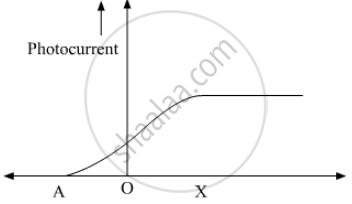
(a) Identify the variable X on the horizontal axis.
(b) What does the point A on the horizontal axis represent?
(c) Draw this graph for three different values of frequencies of incident radiation v1, v2 and v3 (v1 > v2 > v3) for same intensity.
(d) Draw this graph for three different values of intensities of incident radiation I1, I2 and I3 (I1 > I2 > I3) having same frequency.
Can we find the mass of a photon by the definition p = mv?
Planck's constant has the same dimensions as
The work function of a metal is hv0. Light of frequency v falls on this metal. Photoelectric effect will take place only if
A point source of light is used in a photoelectric effect. If the source is removed farther from the emitting metal, the stopping potential
Calculate the momentum of a photon of light of wavelength 500 nm.
(Use h = 6.63 × 10⁻³⁴J-s = 4.14 × 10⁻¹⁵ eV-s, c = 3 × 10⁸ m/s and me = 9.1 × 10⁻³¹kg)
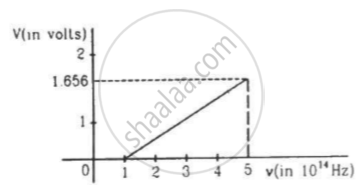
The figure is the plot of stopping potential versus the frequency of the light used in an experiment on photoelectric effect. Find (a) the ratio h/e and (b) the work function.
Explain how does (i) photoelectric current and (ii) kinetic energy of the photoelectrons emitted in a photocell vary if the frequency of incident radiation is doubled, but keeping the intensity same?
Show the graphical variation in the above two cases.
In photoelectric effect, the photoelectric current started to flow. This means that the frequency of incident radiations is ______.
Two monochromatic beams A and B of equal intensity I, hit a screen. The number of photons hitting the screen by beam A is twice that by beam B. Then what inference can you make about their frequencies?
Consider a 20 W bulb emitting light of wavelength 5000 Å and shining on a metal surface kept at a distance 2 m. Assume that the metal surface has work function of 2 eV and that each atom on the metal surface can be treated as a circular disk of radius 1.5 Å.
- Estimate no. of photons emitted by the bulb per second. [Assume no other losses]
- Will there be photoelectric emission?
- How much time would be required by the atomic disk to receive energy equal to work function (2 eV)?
- How many photons would atomic disk receive within time duration calculated in (iii) above?
- Can you explain how photoelectric effect was observed instantaneously?
Read the following paragraph and answer the questions.
| The figure shows the variation of photoelectric current measured in a photocell circuit as a function of the potential difference between the plates of the photocell when light beams A, B, C and D of different wavelengths are incident on the photocell. Examine the given figure and answer the following questions: |

- Which light beam has the highest frequency and why?
- Which light beam has the longest wavelength and why?
- Which light beam ejects photoelectrons with maximum momentum and why?
How would the stopping potential for a given photosensitive surface change if the intensity of incident radiation was decreased? Justify your answer.
The figure shows a plot of stopping potential (V0) versus `1/lambda`, where λ is the wavelength of the radiation causing photoelectric emission from a surface. The slope of the line is equal to ______.

The difference between threshold wavelengths for two metal surfaces A and B having work function ΦA = 9 eV and ΦB = 4.5 eV in nm is ______.
(Given, hc = 1242 eV nm)
Which part provides an entry point for incident radiation?
How does collector plate A help measure current?
Which radiation does quartz window W especially allow to enter the tube?
Which plate is kept illuminated by monochromatic radiation?
When are photoelectrons emitted in relation to the threshold frequency?
