Advertisements
Advertisements
प्रश्न
A sphere of radius 1.00 cm is placed in the path of a parallel beam of light of large aperture. The intensity of the light is 0.5 W cm−2. If the sphere completely absorbs the radiation falling on it, Show that the force on the sphere due to the light falling on it is the same even if the sphere is not perfectly absorbing.
Advertisements
उत्तर
Consider a sphere of centre O and radius OP. As shown in the figure, the radius OP of the sphere is making an angle θ with OZ. Let us rotate the radius about OZ to get another circle on the sphere. The part of the sphere between the circle is a ring of area `2pir^2sin θdθ`.
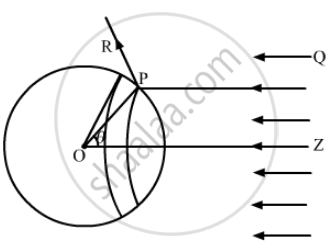
Consider a small part of area `ΔA` of the ring at point P.
Energy of the light falling on this part in time `Δt` ,
`ΔU = I Δ t (ΔA cos θ)`
As the light is reflected by the sphere along PR, the change in momentum ,
`Δp = 2 (ΔU)/c cos θ = 2/c I Δ t (ΔA cos^2 θ)`
Therefore , the force will be
`(Δp)/(Δt) = 2/c I ΔA cos^2 θ`
The Component of force on ΔA , along ZO , is
`(Δp)/(Δt) cos θ = 2/c I ΔA cos^3 θ`
Now , force action on the ring,
`dF = 2/c I (2pir^2 sin θ dθ) cos^3 θ`
The force on the entire sphere ,
`F = ∫_0^(pi/2) (4pir^2I)/c cos^3 θ sin θ dθ`
= `- ∫_0^(pi/2) (4pir^2I)/c cos^3 θd(cos θ)`
= `(pir^2I)/c`
APPEARS IN
संबंधित प्रश्न
Monochromatic radiation of wavelength 640.2 nm (1 nm = 10−9 m) from a neon lamp irradiates photosensitive material made of caesium on tungsten. The stopping voltage is measured to be 0.54 V. The source is replaced by an iron source and its 427.2 nm line irradiates the same photo-cell. Predict the new stopping voltage.
Every metal has a definite work function. Why do all photoelectrons not come out with the same energy if incident radiation is monochromatic? Why is there an energy distribution of photoelectrons?
The following graph shows the variation of photocurrent for a photosensitive metal :
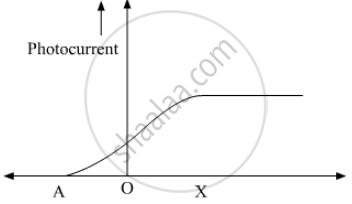
(a) Identify the variable X on the horizontal axis.
(b) What does the point A on the horizontal axis represent?
(c) Draw this graph for three different values of frequencies of incident radiation v1, v2 and v3 (v1 > v2 > v3) for same intensity.
(d) Draw this graph for three different values of intensities of incident radiation I1, I2 and I3 (I1 > I2 > I3) having same frequency.
In an experiment on photoelectric effect, a photon is incident on an electron from one direction and the photoelectron is emitted almost in the opposite direction. Does this violate the principle of conservation of momentum?
The equation E = pc is valid
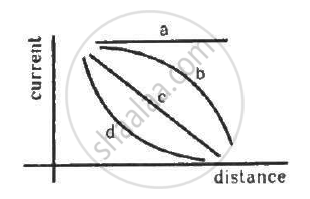
A point source causes photoelectric effect from a small metal plate. Which of the following curves may represent the saturation photocurrent as a function of the distance between the source and the metal?
When the sun is directly overhead, the surface of the earth receives 1.4 × 10³ W m−2 of sunlight. Assume that the light is monochromatic with average wavelength 500 nm and that no light is absorbed in between the sun and the earth's surface. The distance between the sun and the earth is 1.5 × 10¹¹ m. (a) Calculate the number of photons falling per second on each square metre of earth's surface directly below the sun. (b) How many photons are there in each cubic metre near the earth's surface at any instant? (c) How many photons does the sun emit per second?
(Use h = 6.63 × 10⁻³⁴J-s = 4.14 × 10⁻¹⁵ eV-s, c = 3 × 10⁸ m/s and me = 9.1 × 10⁻³¹kg)
A parallel beam of monochromatic light of wavelength 663 nm is incident on a totally reflecting plane mirror. The angle of incidence is 60° and the number of photons striking the mirror per second is 1.0 × 10¹⁹. Calculate the force exerted by the light beam on the mirror.
(Use h = 6.63 × 10⁻³⁴J-s = 4.14 × 10⁻¹⁵ eV-s, c = 3 × 10⁸ m/s and me = 9.1 × 10⁻³¹kg)
Find the maximum magnitude of the linear momentum of a photoelectron emitted when a wavelength of 400 nm falls on a metal with work function 2.5 eV.
(Use h = 6.63 × 10⁻³⁴J-s = 4.14 × 10⁻¹⁵ eV-s, c = 3 × 10⁸ m/s and me = 9.1 × 10⁻³¹kg)
Define the term: threshold frequency
Two monochromatic beams A and B of equal intensity I, hit a screen. The number of photons hitting the screen by beam A is twice that by beam B. Then what inference can you make about their frequencies?
What is studied when light falls on a metal surface?
What type of tube contains the plates in the experimental arrangement?
Which part provides an entry point for incident radiation?
Which apparatus provides monochromatic radiation for illuminating emitter plate C?
How does collector plate A help measure current?
What type of potential can the battery create between the plates?
What is noted when light intensity is changed?
Why does greater light intensity produce more emitted electrons?
How quickly does photoelectric emission occur when suitable radiation falls on the metal surface?
