Advertisements
Advertisements
Question
A sphere of radius 1.00 cm is placed in the path of a parallel beam of light of large aperture. The intensity of the light is 0.5 W cm−2. If the sphere completely absorbs the radiation falling on it, Show that the force on the sphere due to the light falling on it is the same even if the sphere is not perfectly absorbing.
Advertisements
Solution
Consider a sphere of centre O and radius OP. As shown in the figure, the radius OP of the sphere is making an angle θ with OZ. Let us rotate the radius about OZ to get another circle on the sphere. The part of the sphere between the circle is a ring of area `2pir^2sin θdθ`.
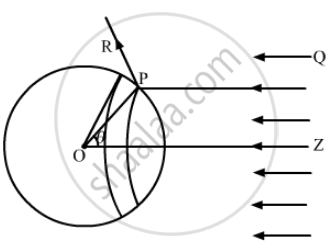
Consider a small part of area `ΔA` of the ring at point P.
Energy of the light falling on this part in time `Δt` ,
`ΔU = I Δ t (ΔA cos θ)`
As the light is reflected by the sphere along PR, the change in momentum ,
`Δp = 2 (ΔU)/c cos θ = 2/c I Δ t (ΔA cos^2 θ)`
Therefore , the force will be
`(Δp)/(Δt) = 2/c I ΔA cos^2 θ`
The Component of force on ΔA , along ZO , is
`(Δp)/(Δt) cos θ = 2/c I ΔA cos^3 θ`
Now , force action on the ring,
`dF = 2/c I (2pir^2 sin θ dθ) cos^3 θ`
The force on the entire sphere ,
`F = ∫_0^(pi/2) (4pir^2I)/c cos^3 θ sin θ dθ`
= `- ∫_0^(pi/2) (4pir^2I)/c cos^3 θd(cos θ)`
= `(pir^2I)/c`
APPEARS IN
RELATED QUESTIONS
The photoelectric cut-off voltage in a certain experiment is 1.5 V. What is the maximum kinetic energy of photoelectrons emitted?
Use the same formula you employ in (a) to obtain electron speed for an collector potential of 10 MV. Do you see what is wrong? In what way is the formula to be modified?
Monochromatic radiation of wavelength 640.2 nm (1 nm = 10−9 m) from a neon lamp irradiates photosensitive material made of caesium on tungsten. The stopping voltage is measured to be 0.54 V. The source is replaced by an iron source and its 427.2 nm line irradiates the same photo-cell. Predict the new stopping voltage.
Is it always true that for two sources of equal intensity, the number of photons emitted in a given time are equal?
A point source of light is used in a photoelectric effect. If the source is removed farther from the emitting metal, the stopping potential
A photon of energy hv is absorbed by a free electron of a metal with work-function hv − φ.
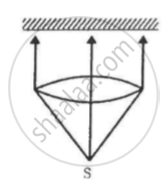
A totally reflecting, small plane mirror placed horizontally faces a parallel beam of light, as shown in the figure. The mass of the mirror is 20 g. Assume that there is no absorption in the lens and that 30% of the light emitted by the source goes through the lens. Find the power of the source needed to support the weight of the mirror.
(Use h = 6.63 × 10⁻³⁴J-s = 4.14 × 10⁻¹⁵ eV-s, c = 3 × 10⁸ m/s and me = 9.1 × 10⁻³¹kg)
A small piece of cesium metal (φ = 1.9 eV) is kept at a distance of 20 cm from a large metal plate with a charge density of 1.0 × 10⁻⁹ C m−2 on the surface facing the cesium piece. A monochromatic light of wavelength 400 nm is incident on the cesium piece. Find the minimum and maximum kinetic energy of the photoelectrons reaching the large metal plate. Neglect any change in electric field due to the small piece of cesium present.
(Use h = 6.63 × 10⁻³⁴J-s = 4.14 × 10⁻¹⁵ eV-s, c = 3 × 10⁸ m/s and me = 9.1 × 10⁻³¹kg)
Define the terms "stopping potential' and 'threshold frequency' in relation to the photoelectric effect. How does one determine these physical quantities using Einstein's equation?
Explain how does (i) photoelectric current and (ii) kinetic energy of the photoelectrons emitted in a photocell vary if the frequency of incident radiation is doubled, but keeping the intensity same?
Show the graphical variation in the above two cases.
Two monochromatic beams A and B of equal intensity I, hit a screen. The number of photons hitting the screen by beam A is twice that by beam B. Then what inference can you make about their frequencies?
The work function for a metal surface is 4.14 eV. The threshold wavelength for this metal surface is ______.
How would the stopping potential for a given photosensitive surface change if the intensity of incident radiation was decreased? Justify your answer.
Plot a graph showing the variation of photoelectric current, as a function of anode potential for two light beams having the same frequency but different intensities I1 and I2 (I1 > I2). Mention its important features.
A metallic plate exposed to white light emits electrons. For which of the following colours of light, the stopping potential will be maximum?
Which part provides an entry point for incident radiation?
Which plate is kept illuminated by monochromatic radiation?
Why does greater light intensity produce more emitted electrons?
What happens if the frequency of incident radiation is below the threshold frequency?
