Advertisements
Advertisements
Question
Ultraviolet light of wavelength 2271 Å from a 100 W mercury source irradiates a photo-cell made of molybdenum metal. If the stopping potential is −1.3 V, estimate the work function of the metal. How would the photo-cell respond to a high intensity (∼105 W m−2) red light of wavelength 6328 Å produced by a He-Ne laser?
Advertisements
Solution
Wavelength of ultraviolet light, λ = 2271 Å = 2271 × 10−10 m
Stopping potential of the metal, V0 = 1.3 V
Planck’s constant, h = 6.6 × 10⁻³⁴ J
Charge on an electron, e = 1.6 × 10⁻¹⁹ C
Work function of the metal = `phi_0`
Frequency of light = v
We have the photo-energy relation from the photoelectric effect as:
`phi_0` = hv − eV0
= `"hc"/lambda - "eV"_0`
= `(6.6 xx 10^(-34) xx 3 xx 10^8)/(2271 xx 10^(-10)) - 1.6 xx 10^(-19) xx 1.3`
= `8.72 xx 10^(-19) - 2.08 xx 10^(-19)`
= `6.64 xx 10^(-19) "J"`
= `(6.64 xx 10^(-19))/(1.6 xx 10^(-19))`
= 4.15 eV
Let v0 be the threshold frequency of the metal.
∴ `phi_0 = "hv"_0`
`"v"_0 = phi_0/"h"`
= `(6.64 xx 10^(-19))/(6.6 xx 10^(-34))`
= 1.006 × 10¹⁵ Hz
Wavelength of red light, `lambda_"r"` = 6328 Å = 6328 × 10−10 m
∴ Frequency of red light, `"v"_"r" = "c"/lambda_"r"`
= `(3 xx 10^8)/(6328 xx 10^(-10))`
= 4.74 × 10¹⁴ Hz
Since v0 > vr, the photocell will not respond to the red light produced by the laser.
APPEARS IN
RELATED QUESTIONS
Define the term 'intensity of radiation' in terms of photon picture of light.
A hot body is placed in a closed room maintained at a lower temperature. Is the number of photons in the room increasing?
Should the energy of a photon be called its kinetic energy or its internal energy?
Two photons of
The work function of a metal is hv0. Light of frequency v falls on this metal. Photoelectric effect will take place only if
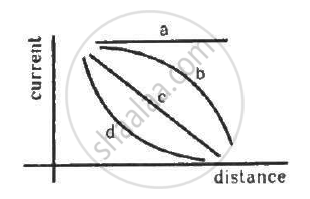
A point source causes photoelectric effect from a small metal plate. Which of the following curves may represent the saturation photocurrent as a function of the distance between the source and the metal?
When the intensity of a light source in increased,
(a) the number of photons emitted by the source in unit time increases
(b) the total energy of the photons emitted per unit time increases
(c) more energetic photons are emitted
(d) faster photons are emitted
A parallel beam of monochromatic light of wavelength 663 nm is incident on a totally reflecting plane mirror. The angle of incidence is 60° and the number of photons striking the mirror per second is 1.0 × 10¹⁹. Calculate the force exerted by the light beam on the mirror.
(Use h = 6.63 × 10⁻³⁴J-s = 4.14 × 10⁻¹⁵ eV-s, c = 3 × 10⁸ m/s and me = 9.1 × 10⁻³¹kg)
A 100 W light bulb is placed at the centre of a spherical chamber of radius 20 cm. Assume that 60% of the energy supplied to the bulb is converted into light and that the surface of the chamber is perfectly absorbing. Find the pressure exerted by the light on the surface of the chamber.
(Use h = 6.63 × 10⁻³⁴J-s = 4.14 × 10⁻¹⁵ eV-s, c = 3 × 10⁸ m/s and me = 9.1 × 10⁻³¹kg)
Explain how does (i) photoelectric current and (ii) kinetic energy of the photoelectrons emitted in a photocell vary if the frequency of incident radiation is doubled, but keeping the intensity same?
Show the graphical variation in the above two cases.
Why it is the frequency and not the intensity of the light source that determines whether the emission of photoelectrons will occur or not? Explain.
The figure shows a plot of stopping potential (V0) versus `1/lambda`, where λ is the wavelength of the radiation causing photoelectric emission from a surface. The slope of the line is equal to ______.

What is the effect of threshold frequency and stopping potential on increasing the frequency of the incident beam of light? Justify your answer.
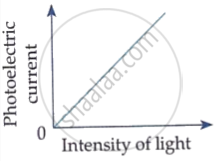
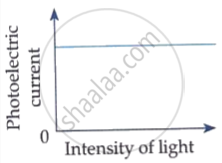
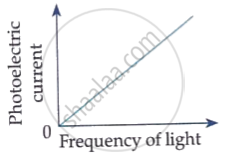
Which of the following options represents the variation of photoelectric current with property of light shown on the x-axis?
Which apparatus measures photocurrent?
What changes the polarity between the plates?
For frequencies above the threshold, how does photocurrent change with increasing incident light intensity?
Why does greater light intensity produce more emitted electrons?
How quickly does photoelectric emission occur when suitable radiation falls on the metal surface?
