Advertisements
Advertisements
Question
Consider a metal exposed to light of wavelength 600 nm. The maximum energy of the electron doubles when light of wavelength 400 nm is used. Find the work function in eV.
Advertisements
Solution
Work function (or threshold energy) (W0): The minimum energy of incident radiation required to eject the electrons from the metallic surface is defined as the work function of that surface.
W0 = hv0 = `(hc)/λ_0` Joules; v0 = Threshold frequency; λ0 = Threshold wavelength
Work function in electron volt, W0(eV) = `(hc)/(eλ_0) = 12375/(λ_0(Å))`
Einstein's photoelectric equation is E = W0 + Kmax
Maximum energy = `hv - phi`
According to the problem for the first condition wavelength of light λ = 600 nm and for the second condition, the wavelength of light λ' = 400 nm
Also, the maximum kinetic energy for the second condition is equal to twice the kinetic energy in the first condition.
i.e., K'max = 2Kmax
then K'max = `(hc)/λ - phi`
⇒ 2Kmax = `(hc)/λ^' - phi`
⇒ `2(1230/600 - phi) = (1230/400 - phi)` ......[∵ hc = 1240 eV nm]
⇒ `phi = 1230/1230` = 1.02 eV
APPEARS IN
RELATED QUESTIONS
Define the term 'intensity of radiation' in terms of photon picture of light.
The photoelectric cut-off voltage in a certain experiment is 1.5 V. What is the maximum kinetic energy of photoelectrons emitted?
Every metal has a definite work function. Why do all photoelectrons not come out with the same energy if incident radiation is monochromatic? Why is there an energy distribution of photoelectrons?
The following graph shows the variation of photocurrent for a photosensitive metal :
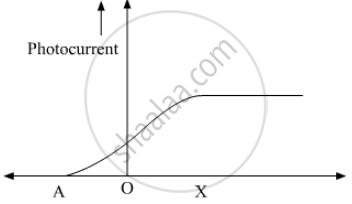
(a) Identify the variable X on the horizontal axis.
(b) What does the point A on the horizontal axis represent?
(c) Draw this graph for three different values of frequencies of incident radiation v1, v2 and v3 (v1 > v2 > v3) for same intensity.
(d) Draw this graph for three different values of intensities of incident radiation I1, I2 and I3 (I1 > I2 > I3) having same frequency.
What is the speed of a photon with respect to another photon if (a) the two photons are going in the same direction and (b) they are going in opposite directions?
In an experiment on photoelectric effect, a photon is incident on an electron from one direction and the photoelectron is emitted almost in the opposite direction. Does this violate the principle of conservation of momentum?
When the intensity of a light source in increased,
(a) the number of photons emitted by the source in unit time increases
(b) the total energy of the photons emitted per unit time increases
(c) more energetic photons are emitted
(d) faster photons are emitted
A photon of energy hv is absorbed by a free electron of a metal with work-function hv − φ.
Define the term: threshold frequency
Explain how does (i) photoelectric current and (ii) kinetic energy of the photoelectrons emitted in a photocell vary if the frequency of incident radiation is doubled, but keeping the intensity same?
Show the graphical variation in the above two cases.
Consider a thin target (10–2 cm square, 10–3 m thickness) of sodium, which produces a photocurrent of 100 µA when a light of intensity 100W/m2 (λ = 660 nm) falls on it. Find the probability that a photoelectron is produced when a photons strikes a sodium atom. [Take density of Na = 0.97 kg/m3].
Consider a 20 W bulb emitting light of wavelength 5000 Å and shining on a metal surface kept at a distance 2 m. Assume that the metal surface has work function of 2 eV and that each atom on the metal surface can be treated as a circular disk of radius 1.5 Å.
- Estimate no. of photons emitted by the bulb per second. [Assume no other losses]
- Will there be photoelectric emission?
- How much time would be required by the atomic disk to receive energy equal to work function (2 eV)?
- How many photons would atomic disk receive within time duration calculated in (iii) above?
- Can you explain how photoelectric effect was observed instantaneously?
If photons of ultraviolet light of energy 12 eV are incident on a metal surface of work function of 4 eV, then the stopping potential (in eV) will be :
The difference between threshold wavelengths for two metal surfaces A and B having work function ΦA = 9 eV and ΦB = 4.5 eV in nm is ______.
(Given, hc = 1242 eV nm)
Which three factors are varied to examine how photocurrent behaves?
Which apparatus applies a potential difference between the plates?
Between which two parts is a potential difference applied?
What is used to change light frequency and study its effect on emission and electron energy?
How quickly does photoelectric emission occur when suitable radiation falls on the metal surface?
