Advertisements
Advertisements
Question
The following graph shows the variation of photocurrent for a photosensitive metal :
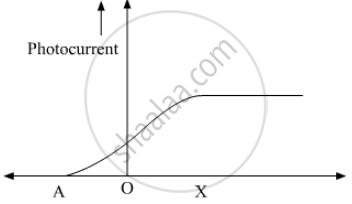
(a) Identify the variable X on the horizontal axis.
(b) What does the point A on the horizontal axis represent?
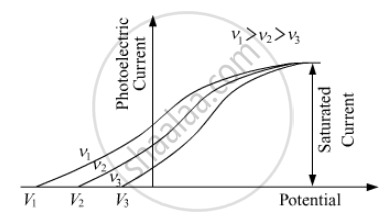
(c) Draw this graph for three different values of frequencies of incident radiation v1, v2 and v3 (v1 > v2 > v3) for same intensity.
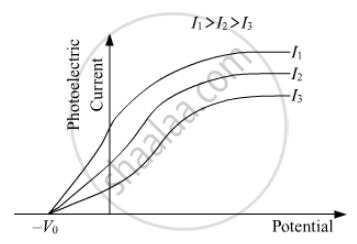
(d) Draw this graph for three different values of intensities of incident radiation I1, I2 and I3 (I1 > I2 > I3) having same frequency.
Advertisements
Solution
(a) Variable X is the accelerating potential applied across the photosensitive material.
(b) A represents the stopping potential for the given photosensitive metal. Stopping potential is the minimum negative potential V0 applied across the photosensitive material at which the photoelectric current becomes zero.
(c) Graph for three different values of frequencies of incident radiation v1, v2 and v3 (v1 > v2 > v3) for same intensity
(d) Graph for three different values of intensities of incident radiation I1, I2 and I3 (I1 > I2 > I3) having same frequency
APPEARS IN
RELATED QUESTIONS
Define the term 'intensity of radiation' in terms of photon picture of light.
The photoelectric cut-off voltage in a certain experiment is 1.5 V. What is the maximum kinetic energy of photoelectrons emitted?
Let nr and nb be the number of photons emitted by a red bulb and a blue bulb, respectively, of equal power in a given time.
A point source of light is used in a photoelectric effect. If the source is removed farther from the emitting metal, the stopping potential
Consider a 20 W bulb emitting light of wavelength 5000 Å and shining on a metal surface kept at a distance 2 m. Assume that the metal surface has work function of 2 eV and that each atom on the metal surface can be treated as a circular disk of radius 1.5 Å.
- Estimate no. of photons emitted by the bulb per second. [Assume no other losses]
- Will there be photoelectric emission?
- How much time would be required by the atomic disk to receive energy equal to work function (2 eV)?
- How many photons would atomic disk receive within time duration calculated in (iii) above?
- Can you explain how photoelectric effect was observed instantaneously?
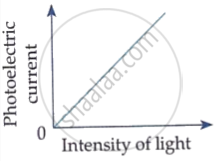
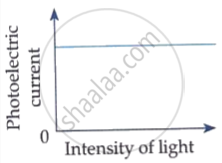
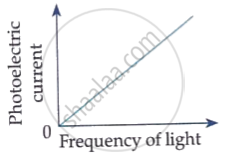
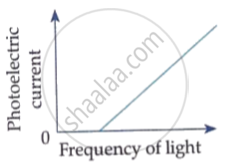
Which of the following options represents the variation of photoelectric current with property of light shown on the x-axis?
Which apparatus provides monochromatic radiation for illuminating emitter plate C?
Why is the polarity reversed during the procedure?
For frequencies above the threshold, how does photocurrent change with increasing incident light intensity?
What happens if the frequency of incident radiation is below the threshold frequency?
