Advertisements
Advertisements
प्रश्न
The following graph shows the variation of photocurrent for a photosensitive metal :
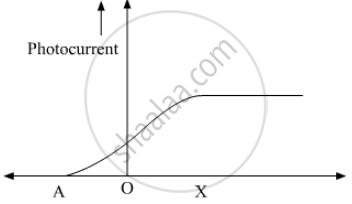
(a) Identify the variable X on the horizontal axis.
(b) What does the point A on the horizontal axis represent?
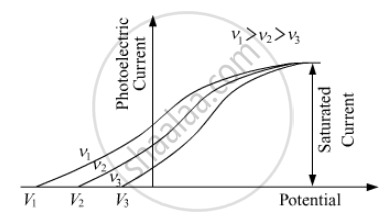
(c) Draw this graph for three different values of frequencies of incident radiation v1, v2 and v3 (v1 > v2 > v3) for same intensity.
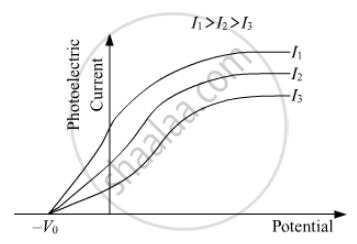
(d) Draw this graph for three different values of intensities of incident radiation I1, I2 and I3 (I1 > I2 > I3) having same frequency.
Advertisements
उत्तर
(a) Variable X is the accelerating potential applied across the photosensitive material.
(b) A represents the stopping potential for the given photosensitive metal. Stopping potential is the minimum negative potential V0 applied across the photosensitive material at which the photoelectric current becomes zero.
(c) Graph for three different values of frequencies of incident radiation v1, v2 and v3 (v1 > v2 > v3) for same intensity
(d) Graph for three different values of intensities of incident radiation I1, I2 and I3 (I1 > I2 > I3) having same frequency
APPEARS IN
संबंधित प्रश्न
Ultraviolet light of wavelength 2271 Å from a 100 W mercury source irradiates a photo-cell made of molybdenum metal. If the stopping potential is −1.3 V, estimate the work function of the metal. How would the photo-cell respond to a high intensity (∼105 W m−2) red light of wavelength 6328 Å produced by a He-Ne laser?
Light of wavelength λ falls on a metal with work-function hc/λ0. Photoelectric effect will take place only if
When the intensity of a light source in increased,
(a) the number of photons emitted by the source in unit time increases
(b) the total energy of the photons emitted per unit time increases
(c) more energetic photons are emitted
(d) faster photons are emitted
Show that it is not possible for a photon to be completely absorbed by a free electron.
The work function of a metal is 2.5 × 10⁻¹⁹ J. (a) Find the threshold frequency for photoelectric emission. (b) If the metal is exposed to a light beam of frequency 6.0 × 10¹⁴ Hz, what will be the stopping potential?
(Use h = 6.63 × 10⁻³⁴J-s = 4.14 × 10⁻¹⁵ eV-s, c = 3 × 10⁸ m/s and me = 9.1 × 10⁻³¹kg)
Plot a graph showing the variation of photoelectric current, as a function of anode potential for two light beams having the same frequency but different intensities I1 and I2 (I1 > I2). Mention its important features.
A metallic plate exposed to white light emits electrons. For which of the following colours of light, the stopping potential will be maximum?
Which part collects electrons emitted from the metal surface?
Which apparatus provides monochromatic radiation for illuminating emitter plate C?
What is noted when light intensity is changed?
