Advertisements
Advertisements
प्रश्न
How would the stopping potential for a given photosensitive surface change if the intensity of incident radiation was decreased? Justify your answer.
Advertisements
उत्तर
A decrease in incident radiation intensity would have no effect on the stopping potential of a certain photosensitive surface. This is because the stopping potential is exclusively determined by frequency rather than intensity of incident radiation. The kinetic energy of photoelectrons is determined only by the frequency of incident radiation, but the number of photoelectrons emitted from the surface is inversely proportional to the intensity of the received light. As a result, decreasing the intensity of the incident radiation would result in fewer photons being produced, but it would have no influence on their kinetic energy or stopping potential.
APPEARS IN
संबंधित प्रश्न
Use the same formula you employ in (a) to obtain electron speed for an collector potential of 10 MV. Do you see what is wrong? In what way is the formula to be modified?
The equation E = pc is valid
The collector plate in an experiment on photoelectric effect is kept vertically above the emitter plate. A light source is put on and a saturation photocurrent is recorded. An electric field is switched on that has a vertically downward direction.
The work function of a metal is 2.5 × 10⁻¹⁹ J. (a) Find the threshold frequency for photoelectric emission. (b) If the metal is exposed to a light beam of frequency 6.0 × 10¹⁴ Hz, what will be the stopping potential?
(Use h = 6.63 × 10⁻³⁴J-s = 4.14 × 10⁻¹⁵ eV-s, c = 3 × 10⁸ m/s and me = 9.1 × 10⁻³¹kg)
In photoelectric effect the photo current ______.
The figure shows a plot of stopping potential (V0) versus `1/lambda`, where λ is the wavelength of the radiation causing photoelectric emission from a surface. The slope of the line is equal to ______.

What is the effect of threshold frequency and stopping potential on increasing the frequency of the incident beam of light? Justify your answer.
Which of the following options represents the variation of photoelectric current with property of light shown on the x-axis?
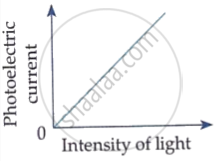
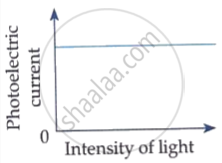
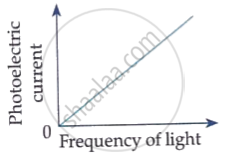
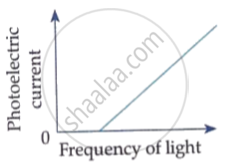
Which plate is kept illuminated by monochromatic radiation?
For frequencies above the threshold, how does photocurrent change with increasing incident light intensity?
