Advertisements
Advertisements
Question
How would the stopping potential for a given photosensitive surface change if the intensity of incident radiation was decreased? Justify your answer.
Advertisements
Solution
A decrease in incident radiation intensity would have no effect on the stopping potential of a certain photosensitive surface. This is because the stopping potential is exclusively determined by frequency rather than intensity of incident radiation. The kinetic energy of photoelectrons is determined only by the frequency of incident radiation, but the number of photoelectrons emitted from the surface is inversely proportional to the intensity of the received light. As a result, decreasing the intensity of the incident radiation would result in fewer photons being produced, but it would have no influence on their kinetic energy or stopping potential.
APPEARS IN
RELATED QUESTIONS
Define the term 'intensity of radiation' in terms of photon picture of light.
The work function of a metal is hv0. Light of frequency v falls on this metal. Photoelectric effect will take place only if
Light of wavelength λ falls on a metal with work-function hc/λ0. Photoelectric effect will take place only if
A totally reflecting, small plane mirror placed horizontally faces a parallel beam of light, as shown in the figure. The mass of the mirror is 20 g. Assume that there is no absorption in the lens and that 30% of the light emitted by the source goes through the lens. Find the power of the source needed to support the weight of the mirror.
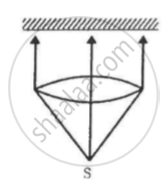
(Use h = 6.63 × 10⁻³⁴J-s = 4.14 × 10⁻¹⁵ eV-s, c = 3 × 10⁸ m/s and me = 9.1 × 10⁻³¹kg)
The electric field associated with a monochromatic beam is 1.2 × 10¹⁵ times per second. Find the maximum kinetic energy of the photoelectrons when this light falls on a metal surface whose work function is 2.0 eV.
(Use h = 6.63 × 10⁻³⁴J-s = 4.14 × 10⁻¹⁵ eV-s, c = 3 × 10⁸ m/s and me = 9.1 × 10⁻³¹kg)
The electric field associated with a light wave is given by `E = E_0 sin [(1.57 xx 10^7 "m"^-1)(x - ct)]`. Find the stopping potential when this light is used in an experiment on photoelectric effect with the emitter having work function 1.9 eV.
(Use h = 6.63 × 10⁻³⁴J-s = 4.14 × 10⁻¹⁵ eV-s, c = 3 × 10⁸ m/s and me = 9.1 × 10⁻³¹kg)
Define the term: threshold frequency
Consider a 20 W bulb emitting light of wavelength 5000 Å and shining on a metal surface kept at a distance 2 m. Assume that the metal surface has work function of 2 eV and that each atom on the metal surface can be treated as a circular disk of radius 1.5 Å.
- Estimate no. of photons emitted by the bulb per second. [Assume no other losses]
- Will there be photoelectric emission?
- How much time would be required by the atomic disk to receive energy equal to work function (2 eV)?
- How many photons would atomic disk receive within time duration calculated in (iii) above?
- Can you explain how photoelectric effect was observed instantaneously?
Which plate is kept illuminated by monochromatic radiation?
After applying a potential difference, how is the resulting photocurrent measured?
