Advertisements
Advertisements
प्रश्न
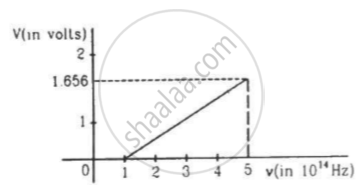
The figure is the plot of stopping potential versus the frequency of the light used in an experiment on photoelectric effect. Find (a) the ratio h/e and (b) the work function.
Advertisements
उत्तर
We have to take two cases.
Case (I)
When stopping potential, `V_0 = 1.656 "Volts"`
Frequency , `v = 5 xx 10^14 "Hz"`
Case (II) When stopping potential , `V_0 = 0`
Frequency , `v=1 xx 10^14 "Hz"`
(b)From Einstein's equation,
`eV_0= hv- W_0`
On substituting the values of case(1) and case(2), we get:
`1.656e= h xx 5 xx 10^14- W_0` ...(1)
`0 = 5 xx h xx 1 xx 10^14 - 5 xx W_0` ...(2)
Subtracting equation(2) from (1), we get:
`W_0= 1.656/4 eV`
= 0.414 eV
(a) Putting the value of W0 in equation (2), we get:
`5W_0= 5h xx 10^14`
`5 xx 0.414= 5 xx h xx 10^14`
`h= 4.414 xx 10^-15 "eVs"`
Or
`h/e= 4.414 xx 10^-15 "Vs"`
APPEARS IN
संबंधित प्रश्न
Define the term 'intensity of radiation' in terms of photon picture of light.
Monochromatic radiation of wavelength 640.2 nm (1 nm = 10−9 m) from a neon lamp irradiates photosensitive material made of caesium on tungsten. The stopping voltage is measured to be 0.54 V. The source is replaced by an iron source and its 427.2 nm line irradiates the same photo-cell. Predict the new stopping voltage.
The work function for the following metals is given:
Na: 2.75 eV; K: 2.30 eV; Mo: 4.17 eV; Ni: 5.15 eV
Which of these metals will not give photoelectric emission for a radiation of wavelength 3300 Å from a He-Cd laser placed 1 m away from the photocell? What happens if the laser is brought nearer and placed 50 cm away?
It is found that yellow light does not eject photoelectrons from a metal. Is it advisable to try with orange light or with green light?
A point source of light is used in a photoelectric effect. If the source is removed farther from the emitting metal, the stopping potential
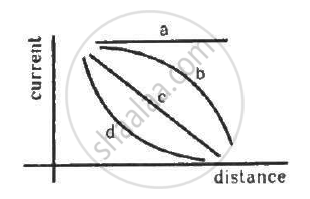
A point source causes photoelectric effect from a small metal plate. Which of the following curves may represent the saturation photocurrent as a function of the distance between the source and the metal?
A parallel beam of monochromatic light of wavelength 663 nm is incident on a totally reflecting plane mirror. The angle of incidence is 60° and the number of photons striking the mirror per second is 1.0 × 10¹⁹. Calculate the force exerted by the light beam on the mirror.
(Use h = 6.63 × 10⁻³⁴J-s = 4.14 × 10⁻¹⁵ eV-s, c = 3 × 10⁸ m/s and me = 9.1 × 10⁻³¹kg)
A small piece of cesium metal (φ = 1.9 eV) is kept at a distance of 20 cm from a large metal plate with a charge density of 1.0 × 10⁻⁹ C m−2 on the surface facing the cesium piece. A monochromatic light of wavelength 400 nm is incident on the cesium piece. Find the minimum and maximum kinetic energy of the photoelectrons reaching the large metal plate. Neglect any change in electric field due to the small piece of cesium present.
(Use h = 6.63 × 10⁻³⁴J-s = 4.14 × 10⁻¹⁵ eV-s, c = 3 × 10⁸ m/s and me = 9.1 × 10⁻³¹kg)
Define the term: threshold frequency
Do all the electrons that absorb a photon come out as photoelectrons?
The figure shows a plot of stopping potential (V0) versus `1/lambda`, where λ is the wavelength of the radiation causing photoelectric emission from a surface. The slope of the line is equal to ______.

- Assertion (A): For the radiation of a frequency greater than the threshold frequency, the photoelectric current is proportional to the intensity of the radiation.
- Reason (R): Greater the number of energy quanta available, the greater the number of electrons absorbing the energy quanta and the greater the number of electrons coming out of the metal.
What is studied when light falls on a metal surface?
Which part provides an entry point for incident radiation?
Which apparatus applies a potential difference between the plates?
Which apparatus measures the potential difference?
What does emitter plate C do when light falls on it?
How does collector plate A help measure current?
When are photoelectrons emitted in relation to the threshold frequency?
