Advertisements
Advertisements
प्रश्न
When a metal plate is exposed to a monochromatic beam of light of wavelength 400 nm, a negative potential of 1.1 V is needed to stop the photo current. Find the threshold wavelength for the metal.
(Use h = 6.63 × 10⁻³⁴J-s = 4.14 × 10⁻¹⁵ eV-s, c = 3 × 10⁸ m/s and me = 9.1 × 10⁻³¹kg)
Advertisements
उत्तर
Given :-
Wavelength of light, `λ = 400 "nm" = 400 xx 10^-9 "m"`
Stopping potential, `V_0 = 1.1 V`
From Einstein's photoelectric equation,
`(hc)/λ = (hc)/(λ_0) + eV_0`,
where h = Planck's constant
c = speed of light
λ = wavelength of light
`λ_0` = threshold wavelength
`V_0` = stopping potential
On substituting the respective values in the above formula , we get :
`(6.63 xx 10^-34 xx 3 xx 10^8)/(400 xx 10^-9) = (6.63 xx 10^-34 xx 3 xx 10^8)/λ_0 + 1.6 xx 10^-19 xx 1.1`
`⇒ 4.97 xx 10^-19 = (19.89 xx 10^-26)/λ_0 + 1.76 xx 10^-19`
`⇒ 4.97 = (19.89 xx 10^-7)/λ_0 + 1.76`
`⇒ (19.89 xx 10^-7)/λ_0 = 4.97 - 1.76 = 3.21`
`⇒ λ_0 = (19.89 xx 10^-7)/3.21`
`= 6.196 xx 10^-7 "m" = 620 "nm"`
APPEARS IN
संबंधित प्रश्न
Use the same formula you employ in (a) to obtain electron speed for an collector potential of 10 MV. Do you see what is wrong? In what way is the formula to be modified?
The work function for the following metals is given:
Na: 2.75 eV; K: 2.30 eV; Mo: 4.17 eV; Ni: 5.15 eV
Which of these metals will not give photoelectric emission for a radiation of wavelength 3300 Å from a He-Cd laser placed 1 m away from the photocell? What happens if the laser is brought nearer and placed 50 cm away?
Every metal has a definite work function. Why do all photoelectrons not come out with the same energy if incident radiation is monochromatic? Why is there an energy distribution of photoelectrons?
Draw graphs showing variation of photoelectric current with applied voltage for two incident radiations of equal frequency and different intensities. Mark the graph for the radiation of higher intensity.
Can a photon be deflected by an electric field? Or by a magnetic field?
Should the energy of a photon be called its kinetic energy or its internal energy?
In an experiment on photoelectric effect, a photon is incident on an electron from one direction and the photoelectron is emitted almost in the opposite direction. Does this violate the principle of conservation of momentum?
If an electron has a wavelength, does it also have a colour?
Let nr and nb be the number of photons emitted by a red bulb and a blue bulb, respectively, of equal power in a given time.
Find the maximum kinetic energy of the photoelectrons ejected when light of wavelength 350 nm is incident on a cesium surface. Work function of cesium = 1.9 eV
(Use h = 6.63 × 10⁻³⁴J-s = 4.14 × 10⁻¹⁵ eV-s, c = 3 × 10⁸ m/s and me = 9.1 × 10⁻³¹kg)
In photoelectric effect the photo current ______.
Consider a thin target (10–2 cm square, 10–3 m thickness) of sodium, which produces a photocurrent of 100 µA when a light of intensity 100W/m2 (λ = 660 nm) falls on it. Find the probability that a photoelectron is produced when a photons strikes a sodium atom. [Take density of Na = 0.97 kg/m3].
Why it is the frequency and not the intensity of the light source that determines whether the emission of photoelectrons will occur or not? Explain.
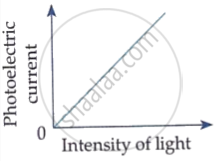
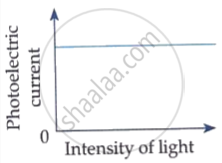
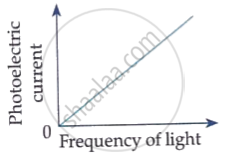
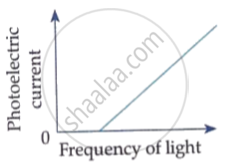
Which of the following options represents the variation of photoelectric current with property of light shown on the x-axis?
Which part collects electrons emitted from the metal surface?
Which apparatus measures photocurrent?
Which plate is kept illuminated by monochromatic radiation?
What is noted when light intensity is changed?
What happens when the collector is made negative with respect to the emitter?
Which observation was one of the major difficulties for classical wave theory?
