Advertisements
Advertisements
प्रश्न
Why it is the frequency and not the intensity of the light source that determines whether the emission of photoelectrons will occur or not? Explain.
Advertisements
उत्तर
The frequency, not the intensity, of the light source, determines the emission because if any incident light of a specific (i.e., threshold or more) frequency is incident, it results in emission regardless of its intensity.
APPEARS IN
संबंधित प्रश्न
If an electron has a wavelength, does it also have a colour?
The equation E = pc is valid
An atom absorbs a photon of wavelength 500 nm and emits another photon of wavelength 700 nm. Find the net energy absorbed by the atom in the process.
(Use h = 6.63 × 10⁻³⁴J-s = 4.14 × 10⁻¹⁵ eV-s, c = 3 × 10⁸ m/s and me = 9.1 × 10⁻³¹kg)
When the sun is directly overhead, the surface of the earth receives 1.4 × 10³ W m−2 of sunlight. Assume that the light is monochromatic with average wavelength 500 nm and that no light is absorbed in between the sun and the earth's surface. The distance between the sun and the earth is 1.5 × 10¹¹ m. (a) Calculate the number of photons falling per second on each square metre of earth's surface directly below the sun. (b) How many photons are there in each cubic metre near the earth's surface at any instant? (c) How many photons does the sun emit per second?
(Use h = 6.63 × 10⁻³⁴J-s = 4.14 × 10⁻¹⁵ eV-s, c = 3 × 10⁸ m/s and me = 9.1 × 10⁻³¹kg)
Define the term: threshold frequency
Consider a metal exposed to light of wavelength 600 nm. The maximum energy of the electron doubles when light of wavelength 400 nm is used. Find the work function in eV.
Which of the following options represents the variation of photoelectric current with property of light shown on the x-axis?
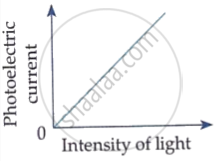
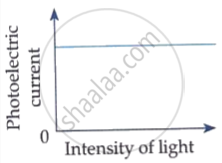
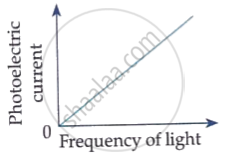
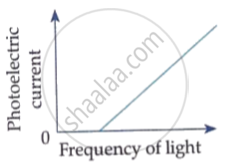
After applying a potential difference, how is the resulting photocurrent measured?
What is noted when light intensity is changed?
What happens if the frequency of incident radiation is below the threshold frequency?
