Advertisements
Advertisements
प्रश्न
A photographic film is coated with a silver bromide layer. When light falls on this film, silver bromide molecules dissociate and the film records the light there. A minimum of 0.6 eV is needed to dissociate a silver bromide molecule. Find the maximum wavelength of light that can be recorded by the film.
(Use h = 6.63 × 10⁻³⁴J-s = 4.14 × 10⁻¹⁵ eV-s, c = 3 × 10⁸ m/s and me = 9.1 × 10⁻³¹kg)
Advertisements
उत्तर
Given:-
Work function, `W_0` = 0.6 eV
Now, work function,
`W_0 = (hc)/λ`,
where, h = Planck's constant
λ = wavelength of light
c = speed of light
`therefore λ = (hc)/(W_0)`
`= (6.63 xx 10^-34 xx 3 xx 10^8)/(0.6 xx 1.6 xx 10^-19)`
`= 20.71 xx 10^-7 "m"`
`= 2071 "nm"`
APPEARS IN
संबंधित प्रश्न
If light of wavelength 412.5 nm is incident on each of the metals given below, which ones will show photoelectric emission and why?
| Metal | Work Function (eV) |
| Na | 1.92 |
| K | 2.15 |
| Ca | 3.20 |
| Mo | 4.17 |
Visible light has wavelengths in the range of 400 nm to 780 nm. Calculate the range of energy of the photons of visible light.
(Use h = 6.63 × 10⁻³⁴J-s = 4.14 × 10⁻¹⁵ eV-s, c = 3 × 10⁸ m/s and me = 9.1 × 10⁻³¹kg)
In an experiment on photoelectric effect, the emitter and the collector plates are placed at a separation of 10 cm and are connected through an ammeter without any cell. A magnetic field B exists parallel to the plates. The work function of the emitter is 2.39 eV and the light incident on it has wavelengths between 400 nm and 600 nm. Find the minimum value of B for which the current registered by the ammeter is zero. Neglect any effect of space charge.
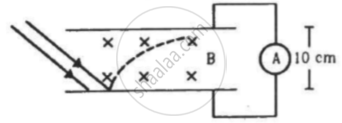
Plot a graph to show the variation of stopping potential with frequency of incident radiation in relation to photoelectric effect.
Work function of aluminium is 4.2 eV. If two photons each of energy 2.5 eV are incident on its surface, will the emission of electrons take place? Justify your answer.
Answer the following question.
Why is the wave theory of electromagnetic radiation not able to explain the photoelectric effect? How does a photon picture resolve this problem?
When a beam of 10.6 eV photons of intensity 2.0 W/m2 falls on a platinum surface of area 1.0 × 10⁻⁴ m2, only 53% of the incident photons eject photoelectrons. The number of photoelectrons emitted per second is ______.
Cathode rays can be deflected by
In photoelectric effect, the photoelectric current
Which phenomena were explained in a natural and satisfactory way by the wave picture of light?
According to the wave picture, what is light?
What does greater radiation intensity mean for the electric and magnetic fields in wave theory?
According to wave theory, how should greater radiation intensity affect the energy absorbed by each electron?
How should the maximum kinetic energy of photoelectrons change with increasing intensity, according to wave theory?
Which wave-theory prediction about maximum kinetic energy contradicts the observed features of photoelectric emission?
Why does the energy absorbed by each electron per unit time become very small in the wave picture?
What energy must an electron gain to escape from the metal?
