Advertisements
Advertisements
प्रश्न
Answer the following question.
Why is the wave theory of electromagnetic radiation not able to explain the photoelectric effect? How does a photon picture resolve this problem?
Advertisements
उत्तर
There are three main drawbacks:
- Intensity: If we consider light as a wave then as the intensity of the light is increased the amplitude of the oscillation of the electron will increase. Thus, as the intensity of the incident light is increased the maximum kinetic energy of the emitted electron will also increase. But it was observed that the kinetic energy of the emitted electrons does not depend on the intensity whereas the magnitude of the photoelectric current increases with the frequency.
- Frequency: If we consider the light as a wave then the photoelectric emission should happen on any frequency, but it was observed that the electrons are emitted after a particular frequency. If the frequency of the incident light is lesser than this frequency there is no photoelectric emission observed.
- Time Delay: According to the wave theory the energy is uniformly distributed over the wavefront. As the light falls on the metallic surface, it will take some time for the electron to gain sufficient energy to get emitted. But experimentally it was observed that the electrons are emitted instantaneously as the light falls on the metallic surface.
How the photon theory can explain the photoelectric effect:
- According to photon theory increasing the intensity means increasing the number of photons that do not change the maximum kinetic energy but changes the number of ejected electrons.
- The energy of a photon is given as E = hf that explains the dependence of the energy on the frequency, after a particular frequency of a photon that is threshold frequency there is photoelectric emission.
- As soon as a photon falls on the metallic surface it is absorbed, hence the electron is ejected instantaneously. Hence, all these are in accordance with the experimental observations.
संबंधित प्रश्न
The threshold frequency for a certain metal is 3.3 × 10¹⁴ Hz. If light of frequency 8.2 × 10¹⁴ Hz is incident on the metal, predict the cut-off voltage for the photoelectric emission.
(a) A monoenergetic electron beam with electron speed of 5.20 × 10⁶ m s−1 is subject to a magnetic field of 1.30 × 10⁻⁴ T normal to the beam velocity. What is the a radius of the circle traced by the beam, given e/m for electron equals 1.76 × 10¹¹ C kg−1?
(b) Is the formula you employ in (a) valid for calculating the radius of the path of a 20 MeV electron beam? If not, in what way is it modified?
What is so special about the combination e/m? Why do we not simply talk of e and m separately?
Visible light has wavelengths in the range of 400 nm to 780 nm. Calculate the range of energy of the photons of visible light.
(Use h = 6.63 × 10⁻³⁴J-s = 4.14 × 10⁻¹⁵ eV-s, c = 3 × 10⁸ m/s and me = 9.1 × 10⁻³¹kg)
In an experiment on photoelectric effect, light of wavelength 400 nm is incident on a cesium plate at the rate of 5.0 W. The potential of the collector plate is made sufficiently positive with respect to the emitter, so that the current reaches its saturation value. Assuming that on average, one out of every 106 photons is able to eject a photoelectron, find the photocurrent in the circuit.
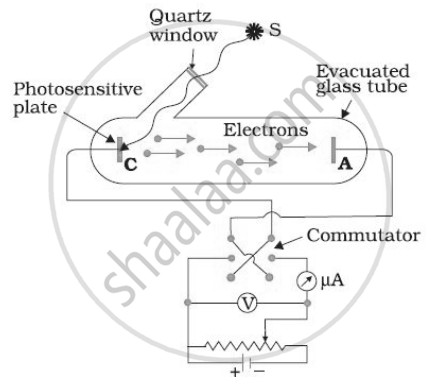
For a given frequency of light and a positive plate potential in the set up below, If the intensity of light is increased then ______.
When a beam of 10.6 eV photons of intensity 2.0 W/m2 falls on a platinum surface of area 1.0 × 10⁻⁴ m2, only 53% of the incident photons eject photoelectrons. The number of photoelectrons emitted per second is ______.
Cathode rays can be deflected by
According to the wave picture, what is light?
What is observed about the timing of photoelectric emission?
