Advertisements
Advertisements
Question
A photographic film is coated with a silver bromide layer. When light falls on this film, silver bromide molecules dissociate and the film records the light there. A minimum of 0.6 eV is needed to dissociate a silver bromide molecule. Find the maximum wavelength of light that can be recorded by the film.
(Use h = 6.63 × 10⁻³⁴J-s = 4.14 × 10⁻¹⁵ eV-s, c = 3 × 10⁸ m/s and me = 9.1 × 10⁻³¹kg)
Advertisements
Solution
Given:-
Work function, `W_0` = 0.6 eV
Now, work function,
`W_0 = (hc)/λ`,
where, h = Planck's constant
λ = wavelength of light
c = speed of light
`therefore λ = (hc)/(W_0)`
`= (6.63 xx 10^-34 xx 3 xx 10^8)/(0.6 xx 1.6 xx 10^-19)`
`= 20.71 xx 10^-7 "m"`
`= 2071 "nm"`
APPEARS IN
RELATED QUESTIONS
Light of frequency 7.21 × 10¹⁴ Hz is incident on a metal surface. Electrons with a maximum speed of 6.0 × 10⁵ m/s are ejected from the surface. What is the threshold frequency for photoemission of electrons?
Is the formula you employ in (a) valid for calculating radius of the path of a 20 MeV electron beam? If not, in what way is it modified?
Visible light has wavelengths in the range of 400 nm to 780 nm. Calculate the range of energy of the photons of visible light.
(Use h = 6.63 × 10⁻³⁴J-s = 4.14 × 10⁻¹⁵ eV-s, c = 3 × 10⁸ m/s and me = 9.1 × 10⁻³¹kg)
A light beam of wavelength 400 nm is incident on a metal plate of work function 2.2 eV. (a) A particular electron absorbs a photon and makes two collisions before coming out of the metal. Assuming that 10% of the extra energy is lost to the metal in each collision, find the kinetic energy of this electron as it comes out of the metal. (b) Under the same assumptions, find the maximum number of collisions the electron can suffer before it becomes unable to come out of the metal.
In the arrangement shown in the figure, y = 1.0 mm, d = 0.24 mm and D = 1.2 m. The work function of the material of the emitter is 2.2 eV. Find the stopping potential V needed to stop the photocurrent.
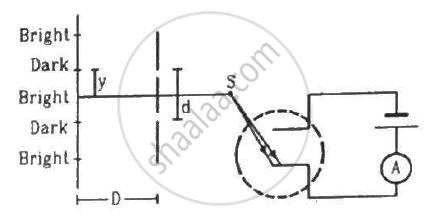
(Use h = 6.63 × 10⁻³⁴J-s = 4.14 × 10⁻¹⁵ eV-s, c = 3 × 10⁸ m/s and me = 9.1 × 10⁻³¹kg)
Plot a graph to show the variation of stopping potential with frequency of incident radiation in relation to photoelectric effect.
The stopping potential in an experiment on photoelectric effect is 1.5V. What is the maximum kinetic energy of the photoelectrons emitted? Calculate in Joules.
In the case of a photo electric effect experiment, explain the following facts, giving reasons.
The wave theory of light could not explain the existence of the threshold frequency.
For a given frequency of light and a positive plate potential in the set up below, If the intensity of light is increased then ______.
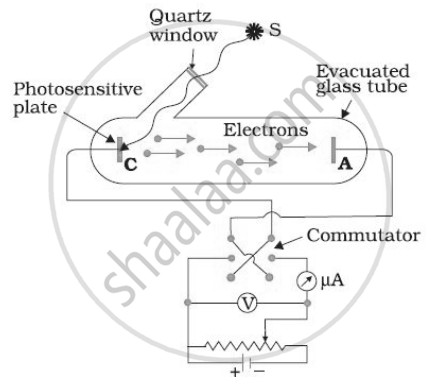
When a beam of 10.6 eV photons of intensity 2.0 W/m2 falls on a platinum surface of area 1.0 × 10⁻⁴ m2, only 53% of the incident photons eject photoelectrons. The number of photoelectrons emitted per second is ______.
Cathode rays can be deflected by
What does greater radiation intensity mean for the electric and magnetic fields in wave theory?
According to wave theory, how should greater radiation intensity affect the energy absorbed by each electron?
How should the maximum kinetic energy of photoelectrons change with increasing intensity, according to wave theory?
What does wave theory predict about the existence of a threshold frequency?
In the wave picture, how does absorption of energy by an electron take place over the radiation?
What is observed about the timing of photoelectric emission?
