Advertisements
Advertisements
प्रश्न
When stopping potential is applied in an experiment on photoelectric effect, no photoelectric is observed. This means that
विकल्प
the emission of photoelectrons is stopped
the photoelectrons are emitted but are re-absorbed
the photoelectrons are accumulated near the collector plate
the photoelectrons are dispersed from the sides of the apparatus
Advertisements
उत्तर
the photoelectrons are emitted but are re-absorbed by the emitter metal
In an experiment on photoelectric effect, the photons incident at the metal plate cause photoelectrons to be emitted. The metal plate is termed as "emitter". The electrons ejected are collected at the other metal plate called "collector". When the potential of the collector is made negative with respect to the emitter (or the stopping potential is applied), the electrons emitted from the emitter are repelled by the collector. As a result, some electrons go back to the cathode and the current decreases.
APPEARS IN
संबंधित प्रश्न
The work function for the following metals is given:
Na: 2.75 eV; K: 2.30 eV; Mo: 4.17 eV; Ni: 5.15 eV
Which of these metals will not give photoelectric emission for a radiation of wavelength 3300 Å from a He-Cd laser placed 1 m away from the photocell? What happens if the laser is brought nearer and placed 50 cm away?
The following graph shows the variation of photocurrent for a photosensitive metal :
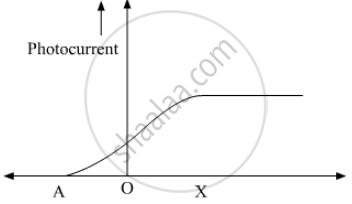
(a) Identify the variable X on the horizontal axis.
(b) What does the point A on the horizontal axis represent?
(c) Draw this graph for three different values of frequencies of incident radiation v1, v2 and v3 (v1 > v2 > v3) for same intensity.
(d) Draw this graph for three different values of intensities of incident radiation I1, I2 and I3 (I1 > I2 > I3) having same frequency.
Is it always true that for two sources of equal intensity, the number of photons emitted in a given time are equal?
Should the energy of a photon be called its kinetic energy or its internal energy?
If an electron has a wavelength, does it also have a colour?
The work function of a metal is hv0. Light of frequency v falls on this metal. Photoelectric effect will take place only if
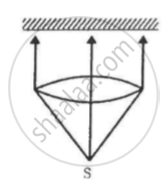
A totally reflecting, small plane mirror placed horizontally faces a parallel beam of light, as shown in the figure. The mass of the mirror is 20 g. Assume that there is no absorption in the lens and that 30% of the light emitted by the source goes through the lens. Find the power of the source needed to support the weight of the mirror.
(Use h = 6.63 × 10⁻³⁴J-s = 4.14 × 10⁻¹⁵ eV-s, c = 3 × 10⁸ m/s and me = 9.1 × 10⁻³¹kg)
A sphere of radius 1.00 cm is placed in the path of a parallel beam of light of large aperture. The intensity of the light is 0.5 W cm−2. If the sphere completely absorbs the radiation falling on it, Show that the force on the sphere due to the light falling on it is the same even if the sphere is not perfectly absorbing.
Show that it is not possible for a photon to be completely absorbed by a free electron.
When a metal plate is exposed to a monochromatic beam of light of wavelength 400 nm, a negative potential of 1.1 V is needed to stop the photo current. Find the threshold wavelength for the metal.
(Use h = 6.63 × 10⁻³⁴J-s = 4.14 × 10⁻¹⁵ eV-s, c = 3 × 10⁸ m/s and me = 9.1 × 10⁻³¹kg)
A small piece of cesium metal (φ = 1.9 eV) is kept at a distance of 20 cm from a large metal plate with a charge density of 1.0 × 10⁻⁹ C m−2 on the surface facing the cesium piece. A monochromatic light of wavelength 400 nm is incident on the cesium piece. Find the minimum and maximum kinetic energy of the photoelectrons reaching the large metal plate. Neglect any change in electric field due to the small piece of cesium present.
(Use h = 6.63 × 10⁻³⁴J-s = 4.14 × 10⁻¹⁵ eV-s, c = 3 × 10⁸ m/s and me = 9.1 × 10⁻³¹kg)
In photoelectric effect, the photoelectric current started to flow. This means that the frequency of incident radiations is ______.
Two monochromatic beams A and B of equal intensity I, hit a screen. The number of photons hitting the screen by beam A is twice that by beam B. Then what inference can you make about their frequencies?
Why it is the frequency and not the intensity of the light source that determines whether the emission of photoelectrons will occur or not? Explain.
If photons of ultraviolet light of energy 12 eV are incident on a metal surface of work function of 4 eV, then the stopping potential (in eV) will be :
A metallic plate exposed to white light emits electrons. For which of the following colours of light, the stopping potential will be maximum?
What type of tube contains the plates in the experimental arrangement?
What is noted when light intensity is changed?
Which observation was one of the major difficulties for classical wave theory?
