Advertisements
Advertisements
प्रश्न
When stopping potential is applied in an experiment on photoelectric effect, no photoelectric is observed. This means that
पर्याय
the emission of photoelectrons is stopped
the photoelectrons are emitted but are re-absorbed
the photoelectrons are accumulated near the collector plate
the photoelectrons are dispersed from the sides of the apparatus
Advertisements
उत्तर
the photoelectrons are emitted but are re-absorbed by the emitter metal
In an experiment on photoelectric effect, the photons incident at the metal plate cause photoelectrons to be emitted. The metal plate is termed as "emitter". The electrons ejected are collected at the other metal plate called "collector". When the potential of the collector is made negative with respect to the emitter (or the stopping potential is applied), the electrons emitted from the emitter are repelled by the collector. As a result, some electrons go back to the cathode and the current decreases.
APPEARS IN
संबंधित प्रश्न
A mercury lamp is a convenient source for studying frequency dependence of photoelectric emission, since it gives a number of spectral lines ranging from the UV to the red end of the visible spectrum. In our experiment with rubidium photo-cell, the following lines from a mercury source were used:
λ1 = 3650 Å, λ2 = 4047 Å, λ3 = 4358 Å, λ4 = 5461 Å, λ5 = 6907 Å,
The stopping voltages, respectively, were measured to be:
V01 = 1.28 V, V02 = 0.95 V, V03 = 0.74 V, V04 = 0.16 V, V05 = 0 V
Determine the value of Planck’s constant h, the threshold frequency and work function for the material.
[Note: You will notice that to get h from the data, you will need to know e (which you can take to be 1.6 × 10⁻¹⁹ C). Experiments of this kind on Na, Li, K, etc. were performed by Millikan, who, using his own value of e (from the oil-drop experiment) confirmed Einstein’s photoelectric equation and at the same time gave an independent estimate of the value of h.]
When the intensity of a light source in increased,
(a) the number of photons emitted by the source in unit time increases
(b) the total energy of the photons emitted per unit time increases
(c) more energetic photons are emitted
(d) faster photons are emitted
A parallel beam of monochromatic light of wavelength 663 nm is incident on a totally reflecting plane mirror. The angle of incidence is 60° and the number of photons striking the mirror per second is 1.0 × 10¹⁹. Calculate the force exerted by the light beam on the mirror.
(Use h = 6.63 × 10⁻³⁴J-s = 4.14 × 10⁻¹⁵ eV-s, c = 3 × 10⁸ m/s and me = 9.1 × 10⁻³¹kg)
A beam of white light is incident normally on a plane surface absorbing 70% of the light and reflecting the rest. If the incident beam carries 10 W of power, find the force exerted by it on the surface.
(Use h = 6.63 × 10⁻³⁴J-s = 4.14 × 10⁻¹⁵ eV-s, c = 3 × 10⁸ m/s and me = 9.1 × 10⁻³¹kg)
The work function of a photoelectric material is 4.0 eV. (a) What is the threshold wavelength? (b) Find the wavelength of light for which the stopping potential is 2.5 V.
(Use h = 6.63 × 10⁻³⁴J-s = 4.14 × 10⁻¹⁵ eV-s, c = 3 × 10⁸ m/s and me = 9.1 × 10⁻³¹kg)
Consider a thin target (10–2 cm square, 10–3 m thickness) of sodium, which produces a photocurrent of 100 µA when a light of intensity 100W/m2 (λ = 660 nm) falls on it. Find the probability that a photoelectron is produced when a photons strikes a sodium atom. [Take density of Na = 0.97 kg/m3].
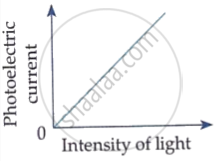
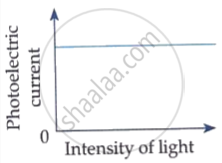
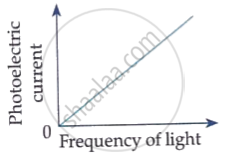
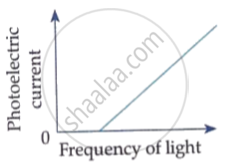
Which of the following options represents the variation of photoelectric current with property of light shown on the x-axis?
The difference between threshold wavelengths for two metal surfaces A and B having work function ΦA = 9 eV and ΦB = 4.5 eV in nm is ______.
(Given, hc = 1242 eV nm)
What is studied when light falls on a metal surface?
Which theory cannot completely explain important observations of photoelectric emission?
Which part provides an entry point for incident radiation?
What does emitter plate C do when light falls on it?
What type of potential can the battery create between the plates?
Which plate is kept illuminated by monochromatic radiation?
After applying a potential difference, how is the resulting photocurrent measured?
Why is the polarity reversed during the procedure?
What is used to change light frequency and study its effect on emission and electron energy?
