Advertisements
Advertisements
प्रश्न
Two monochromatic beams A and B of equal intensity I, hit a screen. The number of photons hitting the screen by beam A is twice that by beam B. Then what inference can you make about their frequencies?
Advertisements
उत्तर
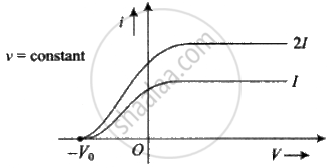
Effect of intensity: If the intensity of light is increased (while its frequency is kept the same) the current levels off at a higher value, showing that more electrons are being emitted per unit of time. But the stopping potential V0 doesn't change, i.e. Intensity `∝` no . of incident photon no. of emitted photoelectron per time photocurrent.
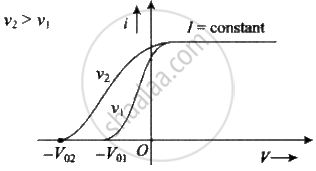
Effect of frequency: If the frequency of incident light increases, (keeping intensity constant) stopping potential increases but there is no change in photoelectric current.
Let us assume nA is the number of photons falling per second of beam A and nB is the number of photons falling per second of beam B.
And it is given that the number of photons hitting the screen by beam A is twice that by beam B.nA = 2nB
The energy of the falling photon of beam A = hvA
The energy of a falling photon of beam B = hvB
Now, according to the question, the intensity of A is equal to the intensity of B.
Therefore, I = nAvA = nBvB
⇒ `v_A/v_B = n_B/n_A = n_B/(2n_B) = 1/2`
⇒ vB = 2vA
APPEARS IN
संबंधित प्रश्न
Ultraviolet light of wavelength 2271 Å from a 100 W mercury source irradiates a photo-cell made of molybdenum metal. If the stopping potential is −1.3 V, estimate the work function of the metal. How would the photo-cell respond to a high intensity (∼105 W m−2) red light of wavelength 6328 Å produced by a He-Ne laser?
A mercury lamp is a convenient source for studying frequency dependence of photoelectric emission, since it gives a number of spectral lines ranging from the UV to the red end of the visible spectrum. In our experiment with rubidium photo-cell, the following lines from a mercury source were used:
λ1 = 3650 Å, λ2 = 4047 Å, λ3 = 4358 Å, λ4 = 5461 Å, λ5 = 6907 Å,
The stopping voltages, respectively, were measured to be:
V01 = 1.28 V, V02 = 0.95 V, V03 = 0.74 V, V04 = 0.16 V, V05 = 0 V
Determine the value of Planck’s constant h, the threshold frequency and work function for the material.
[Note: You will notice that to get h from the data, you will need to know e (which you can take to be 1.6 × 10⁻¹⁹ C). Experiments of this kind on Na, Li, K, etc. were performed by Millikan, who, using his own value of e (from the oil-drop experiment) confirmed Einstein’s photoelectric equation and at the same time gave an independent estimate of the value of h.]
Is it always true that for two sources of equal intensity, the number of photons emitted in a given time are equal?
Can a photon be deflected by an electric field? Or by a magnetic field?
It is found that photosynthesis starts in certain plants when exposed to sunlight, but it does not start if the plants are exposed only to infrared light. Explain.
Planck's constant has the same dimensions as
Two photons of
The work function of a metal is hv0. Light of frequency v falls on this metal. Photoelectric effect will take place only if
If the wavelength of light in an experiment on photoelectric effect is doubled,
(a) photoelectric emission will not take place
(b) photoelectric emission may or may not take place
(c) the stopping potential will increase
(d) the stopping potential will decrease
An atom absorbs a photon of wavelength 500 nm and emits another photon of wavelength 700 nm. Find the net energy absorbed by the atom in the process.
(Use h = 6.63 × 10⁻³⁴J-s = 4.14 × 10⁻¹⁵ eV-s, c = 3 × 10⁸ m/s and me = 9.1 × 10⁻³¹kg)
The work function of a metal is 2.5 × 10⁻¹⁹ J. (a) Find the threshold frequency for photoelectric emission. (b) If the metal is exposed to a light beam of frequency 6.0 × 10¹⁴ Hz, what will be the stopping potential?
(Use h = 6.63 × 10⁻³⁴J-s = 4.14 × 10⁻¹⁵ eV-s, c = 3 × 10⁸ m/s and me = 9.1 × 10⁻³¹kg)
Find the maximum magnitude of the linear momentum of a photoelectron emitted when a wavelength of 400 nm falls on a metal with work function 2.5 eV.
(Use h = 6.63 × 10⁻³⁴J-s = 4.14 × 10⁻¹⁵ eV-s, c = 3 × 10⁸ m/s and me = 9.1 × 10⁻³¹kg)
Define the term: threshold frequency
Explain how does (i) photoelectric current and (ii) kinetic energy of the photoelectrons emitted in a photocell vary if the frequency of incident radiation is doubled, but keeping the intensity same?
Show the graphical variation in the above two cases.
How would the stopping potential for a given photosensitive surface change if the intensity of incident radiation was decreased? Justify your answer.
Plot a graph showing the variation of photoelectric current, as a function of anode potential for two light beams having the same frequency but different intensities I1 and I2 (I1 > I2). Mention its important features.
Which part collects electrons emitted from the metal surface?
Which radiation does quartz window W especially allow to enter the tube?
Which plate is kept illuminated by monochromatic radiation?
Why is the polarity reversed during the procedure?
