Advertisements
Advertisements
प्रश्न
- Assertion (A): For the radiation of a frequency greater than the threshold frequency, the photoelectric current is proportional to the intensity of the radiation.
- Reason (R): Greater the number of energy quanta available, the greater the number of electrons absorbing the energy quanta and the greater the number of electrons coming out of the metal.
विकल्प
If both Assertion and Reason are true and Reason is the correct explanation of Assertion.
If both Assertion and Reason are true but Reason is not the correct explanation of Assertion.
If Assertion is true but Reason is false.
If both Assertion and Reason are false.
Advertisements
उत्तर
If both Assertion and Reason are true and Reason is the correct explanation of Assertion.
Explanation:
When the frequency of the incident radiation exceeds the threshold frequency, the photoelectric current is proportional to the intensity of the radiation. As a result, the assertion is correct. As the intensity rises, so does the number of energy quanta accessible. By absorbing more energy quanta, a bigger number of electrons are emitted. A higher number of electrons equals a higher current. As a result, the photoelectric current becomes proportional to radiation intensity. So, the reason is also true, and it adequately explains the assumption.
APPEARS IN
संबंधित प्रश्न
(a) Estimate the speed with which electrons emitted from a heated emitter of an evacuated tube impinge on the collector maintained at a potential difference of 500 V with respect to the emitter. Ignore the small initial speeds of the electrons. The specific charge of the electron, i.e., its e/m is given to be 1.76 × 10¹¹ C kg−1.
(b) Use the same formula you employ in (a) to obtain electron speed for an collector potential of 10 MV. Do you see what is wrong? In what way is the formula to be modified?
Use the same formula you employ in (a) to obtain electron speed for an collector potential of 10 MV. Do you see what is wrong? In what way is the formula to be modified?
In an experiment on photoelectric effect, a photon is incident on an electron from one direction and the photoelectron is emitted almost in the opposite direction. Does this violate the principle of conservation of momentum?
When stopping potential is applied in an experiment on photoelectric effect, no photoelectric is observed. This means that
A totally reflecting, small plane mirror placed horizontally faces a parallel beam of light, as shown in the figure. The mass of the mirror is 20 g. Assume that there is no absorption in the lens and that 30% of the light emitted by the source goes through the lens. Find the power of the source needed to support the weight of the mirror.
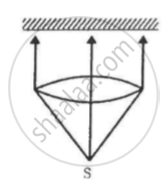
(Use h = 6.63 × 10⁻³⁴J-s = 4.14 × 10⁻¹⁵ eV-s, c = 3 × 10⁸ m/s and me = 9.1 × 10⁻³¹kg)
Find the maximum magnitude of the linear momentum of a photoelectron emitted when a wavelength of 400 nm falls on a metal with work function 2.5 eV.
(Use h = 6.63 × 10⁻³⁴J-s = 4.14 × 10⁻¹⁵ eV-s, c = 3 × 10⁸ m/s and me = 9.1 × 10⁻³¹kg)
Which theory cannot completely explain important observations of photoelectric emission?
What type of tube contains the plates in the experimental arrangement?
Which part collects electrons emitted from the metal surface?
Which apparatus applies a potential difference between the plates?
