Advertisements
Advertisements
प्रश्न
- Assertion (A): For the radiation of a frequency greater than the threshold frequency, the photoelectric current is proportional to the intensity of the radiation.
- Reason (R): Greater the number of energy quanta available, the greater the number of electrons absorbing the energy quanta and the greater the number of electrons coming out of the metal.
पर्याय
If both Assertion and Reason are true and Reason is the correct explanation of Assertion.
If both Assertion and Reason are true but Reason is not the correct explanation of Assertion.
If Assertion is true but Reason is false.
If both Assertion and Reason are false.
Advertisements
उत्तर
If both Assertion and Reason are true and Reason is the correct explanation of Assertion.
Explanation:
When the frequency of the incident radiation exceeds the threshold frequency, the photoelectric current is proportional to the intensity of the radiation. As a result, the assertion is correct. As the intensity rises, so does the number of energy quanta accessible. By absorbing more energy quanta, a bigger number of electrons are emitted. A higher number of electrons equals a higher current. As a result, the photoelectric current becomes proportional to radiation intensity. So, the reason is also true, and it adequately explains the assumption.
APPEARS IN
संबंधित प्रश्न
The photoelectric cut-off voltage in a certain experiment is 1.5 V. What is the maximum kinetic energy of photoelectrons emitted?
(a) Estimate the speed with which electrons emitted from a heated emitter of an evacuated tube impinge on the collector maintained at a potential difference of 500 V with respect to the emitter. Ignore the small initial speeds of the electrons. The specific charge of the electron, i.e., its e/m is given to be 1.76 × 10¹¹ C kg−1.
(b) Use the same formula you employ in (a) to obtain electron speed for an collector potential of 10 MV. Do you see what is wrong? In what way is the formula to be modified?
It is found that yellow light does not eject photoelectrons from a metal. Is it advisable to try with orange light or with green light?
In which of the following situations, the heavier of the two particles has smaller de Broglie wavelength? The two particles
(a) move with the same speed
(b) move with the same linear momentum
(c) move with the same kinetic energy
(d) have fallen through the same height
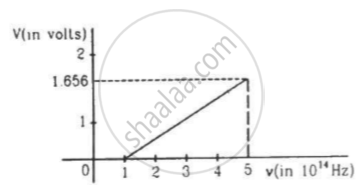
The figure is the plot of stopping potential versus the frequency of the light used in an experiment on photoelectric effect. Find (a) the ratio h/e and (b) the work function.
The graph shows the variation of photocurrent for a photosensitive metal
- What does X and A on the horizontal axis represent?
- Draw this graph for three different values of frequencies of incident radiation ʋ1, ʋ2 and ʋ3 (ʋ3 > ʋ2 > ʋ1) for the same intensity.
- Draw this graph for three different values of intensities of incident radiation I1, I2 and I3 (I3 > I2 > I1) having the same frequency.
If photons of ultraviolet light of energy 12 eV are incident on a metal surface of work function of 4 eV, then the stopping potential (in eV) will be :
How would the stopping potential for a given photosensitive surface change if the intensity of incident radiation was decreased? Justify your answer.
What changes the polarity between the plates?
After applying a potential difference, how is the resulting photocurrent measured?
