Advertisements
Advertisements
प्रश्न
If the wavelength of light in an experiment on photoelectric effect is doubled,
(a) photoelectric emission will not take place
(b) photoelectric emission may or may not take place
(c) the stopping potential will increase
(d) the stopping potential will decrease
Advertisements
उत्तर
(b) photoelectric emission may or may not take place
(d) the stopping potential will decrease
For photoelectric effect to be observed, wavelength of incident light should not be more than the largest wavelength called threshold wavelength `(λ_0)`. If the wavelength of light in an experiment on photoelectric effect is doubled and if it is equal to or less than the threshold wavelength, then photoelectric emission will take place. If it is greater than the threshold wavelength, photoelectric emission will not take place. The photoelectric emission may or may not take place.Photoelectric emission depends on the wavelength of incident light.
Hence, option (b) is correct and (a) is incorrect.
From Einstein's photoelectric equation,
`eV_0 = (hc)/λ_0 - varphi`,
where V0 = stopping potential
`λ_0` = threshold wavelength
h = Planck's constant
`varphi` = work-function of metal
It is clear that
`V_0 ∝ 1/λ_0`
Thus, if the wavelength of light in an experiment on photoelectric effect is doubled, its stopping potential will become half.
APPEARS IN
संबंधित प्रश्न
Every metal has a definite work function. Why do all photoelectrons not come out with the same energy if incident radiation is monochromatic? Why is there an energy distribution of photoelectrons?
Is it always true that for two sources of equal intensity, the number of photons emitted in a given time are equal?
Can a photon be deflected by an electric field? Or by a magnetic field?
If an electron has a wavelength, does it also have a colour?
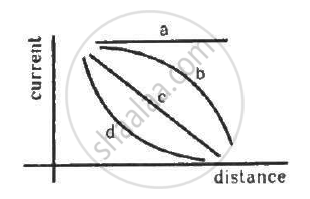
A point source causes photoelectric effect from a small metal plate. Which of the following curves may represent the saturation photocurrent as a function of the distance between the source and the metal?
A parallel beam of monochromatic light of wavelength 663 nm is incident on a totally reflecting plane mirror. The angle of incidence is 60° and the number of photons striking the mirror per second is 1.0 × 10¹⁹. Calculate the force exerted by the light beam on the mirror.
(Use h = 6.63 × 10⁻³⁴J-s = 4.14 × 10⁻¹⁵ eV-s, c = 3 × 10⁸ m/s and me = 9.1 × 10⁻³¹kg)
The work function of a photoelectric material is 4.0 eV. (a) What is the threshold wavelength? (b) Find the wavelength of light for which the stopping potential is 2.5 V.
(Use h = 6.63 × 10⁻³⁴J-s = 4.14 × 10⁻¹⁵ eV-s, c = 3 × 10⁸ m/s and me = 9.1 × 10⁻³¹kg)
Find the maximum magnitude of the linear momentum of a photoelectron emitted when a wavelength of 400 nm falls on a metal with work function 2.5 eV.
(Use h = 6.63 × 10⁻³⁴J-s = 4.14 × 10⁻¹⁵ eV-s, c = 3 × 10⁸ m/s and me = 9.1 × 10⁻³¹kg)
A small piece of cesium metal (φ = 1.9 eV) is kept at a distance of 20 cm from a large metal plate with a charge density of 1.0 × 10⁻⁹ C m−2 on the surface facing the cesium piece. A monochromatic light of wavelength 400 nm is incident on the cesium piece. Find the minimum and maximum kinetic energy of the photoelectrons reaching the large metal plate. Neglect any change in electric field due to the small piece of cesium present.
(Use h = 6.63 × 10⁻³⁴J-s = 4.14 × 10⁻¹⁵ eV-s, c = 3 × 10⁸ m/s and me = 9.1 × 10⁻³¹kg)
In the case of photoelectric effect experiment, explain the following facts, giving reasons.
The photoelectric current increases with increase of intensity of incident light.
In photoelectric effect the photo current ______.
Read the following paragraph and answer the questions.
| The figure shows the variation of photoelectric current measured in a photocell circuit as a function of the potential difference between the plates of the photocell when light beams A, B, C and D of different wavelengths are incident on the photocell. Examine the given figure and answer the following questions: |

- Which light beam has the highest frequency and why?
- Which light beam has the longest wavelength and why?
- Which light beam ejects photoelectrons with maximum momentum and why?
How would the stopping potential for a given photosensitive surface change if the frequency of the incident radiation were increased? Justify your answer.
- Assertion (A): For the radiation of a frequency greater than the threshold frequency, the photoelectric current is proportional to the intensity of the radiation.
- Reason (R): Greater the number of energy quanta available, the greater the number of electrons absorbing the energy quanta and the greater the number of electrons coming out of the metal.
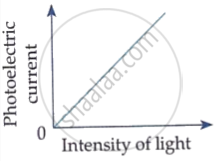
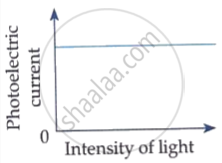
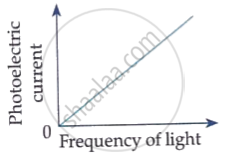
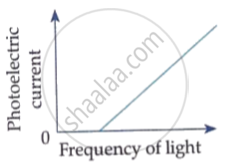
Which of the following options represents the variation of photoelectric current with property of light shown on the x-axis?
Which three factors are varied to examine how photocurrent behaves?
What type of tube contains the plates in the experimental arrangement?
Which apparatus applies a potential difference between the plates?
Which apparatus measures photocurrent?
Which observation was one of the major difficulties for classical wave theory?
