Advertisements
Advertisements
प्रश्न
When the intensity of a light source in increased,
(a) the number of photons emitted by the source in unit time increases
(b) the total energy of the photons emitted per unit time increases
(c) more energetic photons are emitted
(d) faster photons are emitted
Advertisements
उत्तर
(a) the number of photons emitted by the source in unit time increases
(b) the total energy of the photons emitted per unit time increases
When the intensity of a light source in increased, a large number of photons are emitted from the light source. Hence, option (a) is correct.
Due to increase in the number of photons, total energy of the photons emitted per unit time also increases. Hence, option (b) is also correct.
Increase in the intensity of light increases only the number of photons, not the energy of photons, Hence, option (c) is incorrect.
The speed of photons is not affected by the intensity of light, Hence, option (d) is incorrect.
APPEARS IN
संबंधित प्रश्न
A hot body is placed in a closed room maintained at a lower temperature. Is the number of photons in the room increasing?
Should the energy of a photon be called its kinetic energy or its internal energy?
It is found that photosynthesis starts in certain plants when exposed to sunlight, but it does not start if the plants are exposed only to infrared light. Explain.
The threshold wavelength of a metal is λ0. Light of wavelength slightly less than λ0 is incident on an insulated plate made of this metal. It is found that photoelectrons are emitted for some time and after that the emission stops. Explain.
If an electron has a wavelength, does it also have a colour?
If the frequency of light in a photoelectric experiment is doubled, the stopping potential will ______.
In which of the following situations, the heavier of the two particles has smaller de Broglie wavelength? The two particles
(a) move with the same speed
(b) move with the same linear momentum
(c) move with the same kinetic energy
(d) have fallen through the same height
An atom absorbs a photon of wavelength 500 nm and emits another photon of wavelength 700 nm. Find the net energy absorbed by the atom in the process.
(Use h = 6.63 × 10⁻³⁴J-s = 4.14 × 10⁻¹⁵ eV-s, c = 3 × 10⁸ m/s and me = 9.1 × 10⁻³¹kg)
When the sun is directly overhead, the surface of the earth receives 1.4 × 10³ W m−2 of sunlight. Assume that the light is monochromatic with average wavelength 500 nm and that no light is absorbed in between the sun and the earth's surface. The distance between the sun and the earth is 1.5 × 10¹¹ m. (a) Calculate the number of photons falling per second on each square metre of earth's surface directly below the sun. (b) How many photons are there in each cubic metre near the earth's surface at any instant? (c) How many photons does the sun emit per second?
(Use h = 6.63 × 10⁻³⁴J-s = 4.14 × 10⁻¹⁵ eV-s, c = 3 × 10⁸ m/s and me = 9.1 × 10⁻³¹kg)
A totally reflecting, small plane mirror placed horizontally faces a parallel beam of light, as shown in the figure. The mass of the mirror is 20 g. Assume that there is no absorption in the lens and that 30% of the light emitted by the source goes through the lens. Find the power of the source needed to support the weight of the mirror.
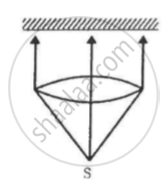
(Use h = 6.63 × 10⁻³⁴J-s = 4.14 × 10⁻¹⁵ eV-s, c = 3 × 10⁸ m/s and me = 9.1 × 10⁻³¹kg)
The work function of a metal is 2.5 × 10⁻¹⁹ J. (a) Find the threshold frequency for photoelectric emission. (b) If the metal is exposed to a light beam of frequency 6.0 × 10¹⁴ Hz, what will be the stopping potential?
(Use h = 6.63 × 10⁻³⁴J-s = 4.14 × 10⁻¹⁵ eV-s, c = 3 × 10⁸ m/s and me = 9.1 × 10⁻³¹kg)
Read the following paragraph and answer the questions.
| The figure shows the variation of photoelectric current measured in a photocell circuit as a function of the potential difference between the plates of the photocell when light beams A, B, C and D of different wavelengths are incident on the photocell. Examine the given figure and answer the following questions: |

- Which light beam has the highest frequency and why?
- Which light beam has the longest wavelength and why?
- Which light beam ejects photoelectrons with maximum momentum and why?
What changes the polarity between the plates?
How does collector plate A help measure current?
Between which two parts is a potential difference applied?
After applying a potential difference, how is the resulting photocurrent measured?
What happens when the collector is made negative with respect to the emitter?
For frequencies above the threshold, how does photocurrent change with increasing incident light intensity?
What happens if the frequency of incident radiation is below the threshold frequency?
Which observation was one of the major difficulties for classical wave theory?
