Advertisements
Advertisements
प्रश्न
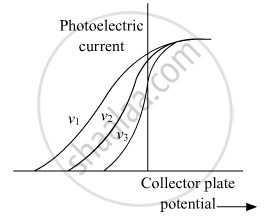
On the basis of the graphs shown in the figure, answer the following questions :
(a) Which physical parameter is kept constant for the three curves?
(b) Which is the highest frequency among v1, v2, and v3?
Advertisements
उत्तर

(a) Intensity is kept constant for all three curves. The given graph shows the variation of photocurrent with collector plate potential for the same intensity of light radiation at various frequencies.
(b) The stopping potential is found to be changing linearly with the frequency of incident light. The stopping potential is more negative for higher frequencies of incident radiation. As an increase in the frequency of the incident light increases the kinetic energy of the emitted electrons, so the greater retarding potential is required to stop them completely.
Hence higher the negative potential, the more the frequency of incident electrons.
As V1 is more negative than V2 and V2 is more negative than V3, hence, V1 > V2 > V3
APPEARS IN
संबंधित प्रश्न
Every metal has a definite work function. Why do all photoelectrons not come out with the same energy if incident radiation is monochromatic? Why is there an energy distribution of photoelectrons?
Can a photon be deflected by an electric field? Or by a magnetic field?
In an experiment on photoelectric effect, the stopping potential is measured for monochromatic light beams corresponding to different wavelengths. The data collected are as follows:-
Wavelength (nm): 350 400 450 500 550
Stopping potential (V): 1.45 1.00 0.66 0.38 0.16
Plot the stopping potential against inverse of wavelength (1/λ) on a graph paper and find (a) Planck's constant (b) the work function of the emitter and (c) the threshold wavelength.
(Use h = 6.63 × 10⁻³⁴J-s = 4.14 × 10⁻¹⁵ eV-s, c = 3 × 10⁸ m/s and me = 9.1 × 10⁻³¹kg)
The electric field associated with a light wave is given by `E = E_0 sin [(1.57 xx 10^7 "m"^-1)(x - ct)]`. Find the stopping potential when this light is used in an experiment on photoelectric effect with the emitter having work function 1.9 eV.
(Use h = 6.63 × 10⁻³⁴J-s = 4.14 × 10⁻¹⁵ eV-s, c = 3 × 10⁸ m/s and me = 9.1 × 10⁻³¹kg)
In photoelectric effect, the photoelectric current started to flow. This means that the frequency of incident radiations is ______.
Which part collects electrons emitted from the metal surface?
Which part provides an entry point for incident radiation?
Why is the polarity reversed during the procedure?
What happens when the collector is made negative with respect to the emitter?
What happens if the frequency of incident radiation is below the threshold frequency?
