Advertisements
Advertisements
Question
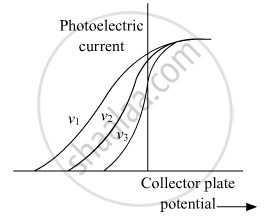
On the basis of the graphs shown in the figure, answer the following questions :
(a) Which physical parameter is kept constant for the three curves?
(b) Which is the highest frequency among v1, v2, and v3?
Advertisements
Solution

(a) Intensity is kept constant for all three curves. The given graph shows the variation of photocurrent with collector plate potential for the same intensity of light radiation at various frequencies.
(b) The stopping potential is found to be changing linearly with the frequency of incident light. The stopping potential is more negative for higher frequencies of incident radiation. As an increase in the frequency of the incident light increases the kinetic energy of the emitted electrons, so the greater retarding potential is required to stop them completely.
Hence higher the negative potential, the more the frequency of incident electrons.
As V1 is more negative than V2 and V2 is more negative than V3, hence, V1 > V2 > V3
APPEARS IN
RELATED QUESTIONS
The photoelectric cut-off voltage in a certain experiment is 1.5 V. What is the maximum kinetic energy of photoelectrons emitted?
In an experiment on photoelectric effect, a photon is incident on an electron from one direction and the photoelectron is emitted almost in the opposite direction. Does this violate the principle of conservation of momentum?
It is found that photosynthesis starts in certain plants when exposed to sunlight, but it does not start if the plants are exposed only to infrared light. Explain.
The equation E = pc is valid
Light of wavelength λ falls on a metal with work-function hc/λ0. Photoelectric effect will take place only if
Answer the following question.
Plot a graph of photocurrent versus anode potential for radiation of frequency ν and intensities I1 and I2 (I1 < I2).
In the case of photoelectric effect experiment, explain the following facts, giving reasons.
The photoelectric current increases with increase of intensity of incident light.
In photoelectric effect the photo current ______.
What type of tube contains the plates in the experimental arrangement?
Which plate is kept illuminated by monochromatic radiation?
