Advertisements
Advertisements
Question
Calculate the momentum of a photon of light of wavelength 500 nm.
(Use h = 6.63 × 10⁻³⁴J-s = 4.14 × 10⁻¹⁵ eV-s, c = 3 × 10⁸ m/s and me = 9.1 × 10⁻³¹kg)
Advertisements
Solution
Given :-
Wavelength of light, λ = 500 nm
Planck's constant, `h = 6.63 xx 10^-34 "J-s"`
Momentum of a photon of light ,
`p = h/ λ`
`= (6.63 xx 10^-34)/(500 xx 10^-9)`
`= 6.63/5 xx 10^-27`
`= 1.326 xx 10^-27`
`= 1.33 xx 10^-27 "kg"-m"/"s`
APPEARS IN
RELATED QUESTIONS
Use the same formula you employ in (a) to obtain electron speed for an collector potential of 10 MV. Do you see what is wrong? In what way is the formula to be modified?
A hot body is placed in a closed room maintained at a lower temperature. Is the number of photons in the room increasing?
If an electron has a wavelength, does it also have a colour?
The equation E = pc is valid
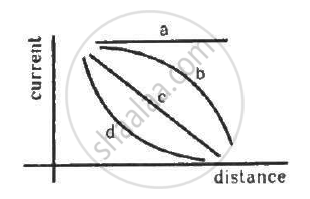
A point source causes photoelectric effect from a small metal plate. Which of the following curves may represent the saturation photocurrent as a function of the distance between the source and the metal?
The collector plate in an experiment on photoelectric effect is kept vertically above the emitter plate. A light source is put on and a saturation photocurrent is recorded. An electric field is switched on that has a vertically downward direction.
Calculate the number of photons emitted per second by a 10 W sodium vapour lamp. Assume that 60% of the consumed energy is converted into light. Wavelength of sodium light = 590 nm
(Use h = 6.63 × 10⁻³⁴J-s = 4.14 × 10⁻¹⁵ eV-s, c = 3 × 10⁸ m/s and me = 9.1 × 10⁻³¹kg)
A sphere of radius 1.00 cm is placed in the path of a parallel beam of light of large aperture. The intensity of the light is 0.5 W cm−2. If the sphere completely absorbs the radiation falling on it, find the force exerted by the light beam on the sphere.
(Use h = 6.63 × 10⁻³⁴J-s = 4.14 × 10⁻¹⁵ eV-s, c = 3 × 10⁸ m/s and me = 9.1 × 10⁻³¹kg)
The electric field associated with a light wave is given by `E = E_0 sin [(1.57 xx 10^7 "m"^-1)(x - ct)]`. Find the stopping potential when this light is used in an experiment on photoelectric effect with the emitter having work function 1.9 eV.
(Use h = 6.63 × 10⁻³⁴J-s = 4.14 × 10⁻¹⁵ eV-s, c = 3 × 10⁸ m/s and me = 9.1 × 10⁻³¹kg)
In photoelectric effect the photo current ______.
Do all the electrons that absorb a photon come out as photoelectrons?
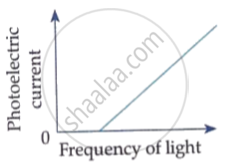
Which of the following options represents the variation of photoelectric current with property of light shown on the x-axis?
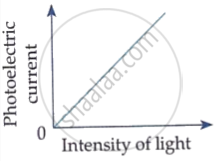
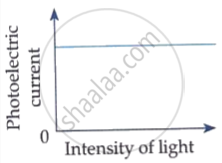
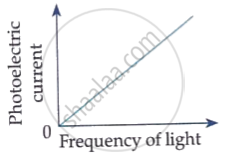
Which part collects electrons emitted from the metal surface?
What does emitter plate C do when light falls on it?
What type of potential can the battery create between the plates?
Which plate is kept illuminated by monochromatic radiation?
After applying a potential difference, how is the resulting photocurrent measured?
What is noted when light intensity is changed?
What is used to change light frequency and study its effect on emission and electron energy?
