Advertisements
Advertisements
Question
The electric field associated with a light wave is given by `E = E_0 sin [(1.57 xx 10^7 "m"^-1)(x - ct)]`. Find the stopping potential when this light is used in an experiment on photoelectric effect with the emitter having work function 1.9 eV.
(Use h = 6.63 × 10⁻³⁴J-s = 4.14 × 10⁻¹⁵ eV-s, c = 3 × 10⁸ m/s and me = 9.1 × 10⁻³¹kg)
Advertisements
Solution
Given :-
Electric field , `E = E_0 sin [(1.57 xx 10^7 "m"^-1)(x - ct)]`
Work function, `phi = 1.9 "eV"`
On comparing the given equation with the standard equation, `E = E_0 sin (kx - wt)`,
we get :-
`omega = 1.57 xx 10^7 xx c`
Now , frequency,
`v = (1.57 xx 10^7 xx 3 xx 10^8)/(2pi) Hz`
From Einstein's photoelectric equation,
`"eV"_0 = hv - phi`
Here, V0 = stopping potential
e = charge on electron
h = Planck's constant
On substituting the respective values, we get :-
`"eV"_0 = 6.63 xx 10^-34 xx (1.57 xx 3 xx 10^15)/(2pi xx 1.6 xx 10^-19) - 1.9 "eV"`
`⇒ "eV"_0 = 3.105 - 1.9 = 1.205 "eV"`
`⇒ V_0 = (1.205 xx 1.6 xx 10^-19)/(1.6 xx 10^-19) = 1.205 V`
Thus, the value of the stopping potential is 1.205 V.
APPEARS IN
RELATED QUESTIONS
Two photons of
A point source of light is used in a photoelectric effect. If the source is removed farther from the emitting metal, the stopping potential
A photon of energy hv is absorbed by a free electron of a metal with work-function hv − φ.
If the wavelength of light in an experiment on photoelectric effect is doubled,
(a) photoelectric emission will not take place
(b) photoelectric emission may or may not take place
(c) the stopping potential will increase
(d) the stopping potential will decrease
The collector plate in an experiment on photoelectric effect is kept vertically above the emitter plate. A light source is put on and a saturation photocurrent is recorded. An electric field is switched on that has a vertically downward direction.
An atom absorbs a photon of wavelength 500 nm and emits another photon of wavelength 700 nm. Find the net energy absorbed by the atom in the process.
(Use h = 6.63 × 10⁻³⁴J-s = 4.14 × 10⁻¹⁵ eV-s, c = 3 × 10⁸ m/s and me = 9.1 × 10⁻³¹kg)
Calculate the number of photons emitted per second by a 10 W sodium vapour lamp. Assume that 60% of the consumed energy is converted into light. Wavelength of sodium light = 590 nm
(Use h = 6.63 × 10⁻³⁴J-s = 4.14 × 10⁻¹⁵ eV-s, c = 3 × 10⁸ m/s and me = 9.1 × 10⁻³¹kg)
A totally reflecting, small plane mirror placed horizontally faces a parallel beam of light, as shown in the figure. The mass of the mirror is 20 g. Assume that there is no absorption in the lens and that 30% of the light emitted by the source goes through the lens. Find the power of the source needed to support the weight of the mirror.
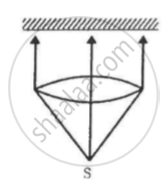
(Use h = 6.63 × 10⁻³⁴J-s = 4.14 × 10⁻¹⁵ eV-s, c = 3 × 10⁸ m/s and me = 9.1 × 10⁻³¹kg)
In the case of photoelectric effect experiment, explain the following facts, giving reasons.
The photoelectric current increases with increase of intensity of incident light.
Explain how does (i) photoelectric current and (ii) kinetic energy of the photoelectrons emitted in a photocell vary if the frequency of incident radiation is doubled, but keeping the intensity same?
Show the graphical variation in the above two cases.
In photoelectric effect, the photoelectric current started to flow. This means that the frequency of incident radiations is ______.
- Assertion (A): For the radiation of a frequency greater than the threshold frequency, the photoelectric current is proportional to the intensity of the radiation.
- Reason (R): Greater the number of energy quanta available, the greater the number of electrons absorbing the energy quanta and the greater the number of electrons coming out of the metal.
What type of tube contains the plates in the experimental arrangement?
What does emitter plate C do when light falls on it?
What type of potential can the battery create between the plates?
Which plate is kept illuminated by monochromatic radiation?
After applying a potential difference, how is the resulting photocurrent measured?
What is noted when light intensity is changed?
For frequencies above the threshold, how does photocurrent change with increasing incident light intensity?
