Advertisements
Advertisements
प्रश्न
A beam of white light is incident normally on a plane surface absorbing 70% of the light and reflecting the rest. If the incident beam carries 10 W of power, find the force exerted by it on the surface.
(Use h = 6.63 × 10⁻³⁴J-s = 4.14 × 10⁻¹⁵ eV-s, c = 3 × 10⁸ m/s and me = 9.1 × 10⁻³¹kg)
Advertisements
उत्तर
Power of the incident beam, P = 10 watt
Relation between wavelength (λ) and momentum (p):
`λ = h/p` ,
where h is Planck's constant
⇒ `p = h/λ`
On dividing both sides by t , we get :
`p/t = h/(λt)` ...(1)
Energy,
`E = (hc)/λ`
⇒ `E/t = (hc)/(λt)`
Let P be the power . Then,
`P = E/t = (hc)/(λt)`
`P = (pc)/t ................["Using equation (1)"]`
⇒` p/c = p/t`
Force ,
`F = p/t = p/c` `("Since F" = "Momentum"/"Time")`
`"Force, F" = 7/10 " (absorted)" + 2 xx 3/10 ("reflected")`
`F = 7/10 xx P/c + 2 xx 3/10 xx P/c`
`F = 7/10 xx 10/(3 xx 10^8) + 2 xx 3/10 xx 10/(3 xx 10^8)`
`F = 13/3 xx 10^-8 = 4.33 xx 10^-8 "N"`
APPEARS IN
संबंधित प्रश्न
Is it always true that for two sources of equal intensity, the number of photons emitted in a given time are equal?
What is the speed of a photon with respect to another photon if (a) the two photons are going in the same direction and (b) they are going in opposite directions?
Can a photon be deflected by an electric field? Or by a magnetic field?
Should the energy of a photon be called its kinetic energy or its internal energy?
It is found that photosynthesis starts in certain plants when exposed to sunlight, but it does not start if the plants are exposed only to infrared light. Explain.
An atom absorbs a photon of wavelength 500 nm and emits another photon of wavelength 700 nm. Find the net energy absorbed by the atom in the process.
(Use h = 6.63 × 10⁻³⁴J-s = 4.14 × 10⁻¹⁵ eV-s, c = 3 × 10⁸ m/s and me = 9.1 × 10⁻³¹kg)
Show that it is not possible for a photon to be completely absorbed by a free electron.
The electric field associated with a light wave is given by `E = E_0 sin [(1.57 xx 10^7 "m"^-1)(x - ct)]`. Find the stopping potential when this light is used in an experiment on photoelectric effect with the emitter having work function 1.9 eV.
(Use h = 6.63 × 10⁻³⁴J-s = 4.14 × 10⁻¹⁵ eV-s, c = 3 × 10⁸ m/s and me = 9.1 × 10⁻³¹kg)
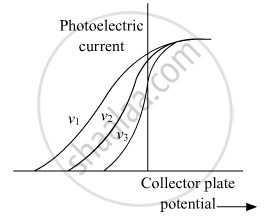
On the basis of the graphs shown in the figure, answer the following questions :
(a) Which physical parameter is kept constant for the three curves?
(b) Which is the highest frequency among v1, v2, and v3?
In the case of photoelectric effect experiment, explain the following facts, giving reasons.
The photoelectric current increases with increase of intensity of incident light.
Define the term: stopping potential in the photoelectric effect.
Consider a metal exposed to light of wavelength 600 nm. The maximum energy of the electron doubles when light of wavelength 400 nm is used. Find the work function in eV.
Why it is the frequency and not the intensity of the light source that determines whether the emission of photoelectrons will occur or not? Explain.
If photons of ultraviolet light of energy 12 eV are incident on a metal surface of work function of 4 eV, then the stopping potential (in eV) will be :
The difference between threshold wavelengths for two metal surfaces A and B having work function ΦA = 9 eV and ΦB = 4.5 eV in nm is ______.
(Given, hc = 1242 eV nm)
What does emitter plate C do when light falls on it?
When are photoelectrons emitted in relation to the threshold frequency?
How quickly does photoelectric emission occur when suitable radiation falls on the metal surface?
Which observation was one of the major difficulties for classical wave theory?
