Advertisements
Advertisements
प्रश्न
Should the energy of a photon be called its kinetic energy or its internal energy?
Advertisements
उत्तर
Relativistic equation of energy :
`E^2 = p^2c^2 + m^2c^4` ....(1)
Here, p2c2 = kinetic energy of photon
m02c4 = internal energy of photon
We know photons have zero rest mass. Therefore, m0 = 0. Substituting the value of m0 = 0 in equation (1), we get : `E = pc`
Thus, the energy of a photon should be called its kinetic energy.
APPEARS IN
संबंधित प्रश्न
Draw graphs showing variation of photoelectric current with applied voltage for two incident radiations of equal frequency and different intensities. Mark the graph for the radiation of higher intensity.
What is the speed of a photon with respect to another photon if (a) the two photons are going in the same direction and (b) they are going in opposite directions?
A hot body is placed in a closed room maintained at a lower temperature. Is the number of photons in the room increasing?
The equation E = pc is valid
If the frequency of light in a photoelectric experiment is doubled, the stopping potential will ______.
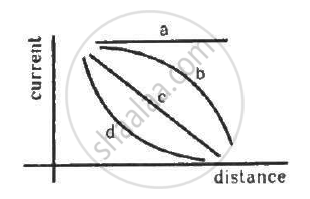
A point source causes photoelectric effect from a small metal plate. Which of the following curves may represent the saturation photocurrent as a function of the distance between the source and the metal?
The collector plate in an experiment on photoelectric effect is kept vertically above the emitter plate. A light source is put on and a saturation photocurrent is recorded. An electric field is switched on that has a vertically downward direction.
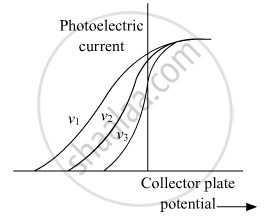
On the basis of the graphs shown in the figure, answer the following questions :
(a) Which physical parameter is kept constant for the three curves?
(b) Which is the highest frequency among v1, v2, and v3?
In the case of photoelectric effect experiment, explain the following facts, giving reasons.
The photoelectric current increases with increase of intensity of incident light.
Explain how does (i) photoelectric current and (ii) kinetic energy of the photoelectrons emitted in a photocell vary if the frequency of incident radiation is doubled, but keeping the intensity same?
Show the graphical variation in the above two cases.
In photoelectric effect, the photoelectric current started to flow. This means that the frequency of incident radiations is ______.
The graph shows the variation of photocurrent for a photosensitive metal
- What does X and A on the horizontal axis represent?
- Draw this graph for three different values of frequencies of incident radiation ʋ1, ʋ2 and ʋ3 (ʋ3 > ʋ2 > ʋ1) for the same intensity.
- Draw this graph for three different values of intensities of incident radiation I1, I2 and I3 (I3 > I2 > I1) having the same frequency.
Plot a graph showing the variation of photoelectric current, as a function of anode potential for two light beams having the same frequency but different intensities I1 and I2 (I1 > I2). Mention its important features.
What is studied when light falls on a metal surface?
Which three factors are varied to examine how photocurrent behaves?
Which part collects electrons emitted from the metal surface?
What does emitter plate C do when light falls on it?
What is noted when light intensity is changed?
Why does greater light intensity produce more emitted electrons?
Which observation was one of the major difficulties for classical wave theory?
