Advertisements
Advertisements
प्रश्न
Find the magnetic field due to a long straight conductor using Ampere’s circuital law.
Advertisements
उत्तर
Consider a straight conductor of infinite length carrying current I and the direction of magnetic field lines. Since the wire is geometrically cylindrical in shape C and symmetrical about its axis, we construct an Amperian loop in the form of a circular shape at a distance r from the centre of the conductor. From the Ampere’s law, we get
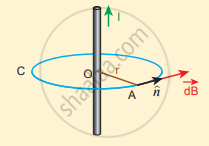
Ampèrian loop for current carrying straight wire
`oint_"C" vec"B"*"d"vec"l" = mu_0 "I"`
Where dl is the line element along the amperian loop (tangent to the circular loop). Hence, the angle between the magnetic field vector and line element is zero. Therefore,
`oint_"C" "B"*"dl" = mu_0 "I"`
where I is the current enclosed by the Amperian loop. Due to the symmetry, the magnitude of the magnetic field is uniform over the Amperian loop, we can take B out of the integration.
`"B"oint_"C" "dl" = mu_0"I"`
For a circular loop, the circumference is 2πr, which implies,
`"B"int_hat"n"^(2pi"r") "dl" = mu_0 "I"`
`vec"B"*2pi"r" = mmu_0"I"`
`=> vec"B" = (mu_0"I")/(2pi"r")`
In vector form, the magnetic field is
`vec"B" = (mu_0"I")/(2pi"r")hat"n"`
Where `hat"n"` is the unit vector along the tangent to the Amperian loop. This perfectly agrees with the result obtained from Biot-Savarf s law as given in equation
`vec"B" = (mu_0"I")/(2pi"a") hat"n"`
APPEARS IN
संबंधित प्रश्न
Explain Ampere’s circuital law.
A long, straight wire carries a current. Is Ampere's law valid for a loop that does not enclose the wire, or that encloses the wire but is not circular?
A solid wire of radius 10 cm carries a current of 5.0 A distributed uniformly over its cross section. Find the magnetic field B at a point at a distance (a) 2 cm (b) 10 cm and (c) 20 cm away from the axis. Sketch a graph B versus x for 0 < x < 20 cm.
Using Ampere's circuital law, obtain an expression for the magnetic flux density 'B' at a point 'X' at a perpendicular distance 'r' from a long current-carrying conductor.
(Statement of the law is not required).
The wires which connect the battery of an automobile to its starting motor carry a current of 300 A (for a short time). What is the force per unit length between the wires if they are 70 cm long and 1.5 cm apart? Is the force attractive or repulsive?
In a capillary tube, the water rises by 1.2 mm. The height of water that will rise in another capillary tube having half the radius of the first is:
Ampere's circuital law is used to find out ______
