Advertisements
Advertisements
Question
Find the magnetic field due to a long straight conductor using Ampere’s circuital law.
Advertisements
Solution
Consider a straight conductor of infinite length carrying current I and the direction of magnetic field lines. Since the wire is geometrically cylindrical in shape C and symmetrical about its axis, we construct an Amperian loop in the form of a circular shape at a distance r from the centre of the conductor. From the Ampere’s law, we get
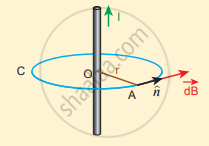
Ampèrian loop for current carrying straight wire
`oint_"C" vec"B"*"d"vec"l" = mu_0 "I"`
Where dl is the line element along the amperian loop (tangent to the circular loop). Hence, the angle between the magnetic field vector and line element is zero. Therefore,
`oint_"C" "B"*"dl" = mu_0 "I"`
where I is the current enclosed by the Amperian loop. Due to the symmetry, the magnitude of the magnetic field is uniform over the Amperian loop, we can take B out of the integration.
`"B"oint_"C" "dl" = mu_0"I"`
For a circular loop, the circumference is 2πr, which implies,
`"B"int_hat"n"^(2pi"r") "dl" = mu_0 "I"`
`vec"B"*2pi"r" = mmu_0"I"`
`=> vec"B" = (mu_0"I")/(2pi"r")`
In vector form, the magnetic field is
`vec"B" = (mu_0"I")/(2pi"r")hat"n"`
Where `hat"n"` is the unit vector along the tangent to the Amperian loop. This perfectly agrees with the result obtained from Biot-Savarf s law as given in equation
`vec"B" = (mu_0"I")/(2pi"a") hat"n"`
APPEARS IN
RELATED QUESTIONS
Using Ampere’s circuital law, obtain the expression for the magnetic field due to a long solenoid at a point inside the solenoid on its axis ?
A long, straight wire carries a current. Is Ampere's law valid for a loop that does not enclose the wire, or that encloses the wire but is not circular?
A long, cylindrical tube of inner and outer radii a and b carries a current i distributed uniformly over its cross section. Find the magnitude of the magnitude filed at a point (a) just inside the tube (b) just outside the tube.
Using Ampere's circuital law, obtain an expression for the magnetic flux density 'B' at a point 'X' at a perpendicular distance 'r' from a long current-carrying conductor.
(Statement of the law is not required).
What is magnetic permeability?
Which law provides a simpler alternative method for finding the magnetic field \[B\] when the current distribution has symmetry (straight wire, solenoid, toroid)?
In the sign convention for Ampere's law, if the fingers of the right hand curl along the direction of integration (\[d\vec{l}\]), the thumb points:
