Advertisements
Advertisements
प्रश्न
Two concentric and coplanar circular loops P and Q have their radii in the ratio 2:3. Loop Q carries a current 9 A in the anticlockwise direction. For the magnetic field to be zero at the common centre, loop P must carry ______.
विकल्प
3 A in clockwise direction
9 A in clockwise direction
6 A in anti-clockwise direction
6 A in the clockwise direction
Advertisements
उत्तर
Two concentric and coplanar circular loops P and Q have their radii in the ratio 2:3. Loop Q carries a current 9 A in the anticlockwise direction. For the magnetic field to be zero at the common centre, loop P must carry 6 A in the clockwise direction.
Explanation:
Given: The ratio of the radius of the loops P and Q = 2:3
Current in the loop Q = 9 A in (anticlockwise direction)
To Find: The current in loop P for which the magnetic field at the common centre becomes zero.
⇒ The intensity of the magnetic field (B) at the centre of a circular current-carrying coil is given by the formula:
Magnetic Field (B) = `(μ_0i)/(2R)`
- Where 'i' is the current flowing through the circular coil.
- Here 'R' is the radius of the circular coil.
- 'μ0' is a constant known as the permeability constant of free space.
⇒ The direction of the magnetic field due to the circular current-carrying coil is given by the right-hand thumb rule.
According to this law, if we curl our right-hand palm around the current-carrying loop with fingers pointing in the direction of the current flow, then the direction of our right-hand thumb will give us the direction of the Magnetic field.
⇒ In the given question, the current in loop Q is flowing in the anticlockwise direction. Therefore for the resultant magnetic field to be zero at the common centre, the current in the loop P must flow in the clockwise direction.
Let the magnetic field due to the loop P be 'B1'
Let the magnetic field due to the loop Q be 'B2'
Let the current through the loop P be 'i1'
The ratio of the radius of the loops P and Q is R1:R2 is equal to 2:3.
⇒ The magnetic field 'B1' due to the current-carrying loop P is given by:
B1 = `(μ_0i_1)/(2R_1)` – Equation (i)
⇒ The magnetic field 'B2' due to the current-carrying loop Q is given by:
B2 = `(μ_0i_2)/(2R_2)` – Equation (ii)
⇒ Equating the equations (i) and (ii):
∵ B1 = B2
∴ `(μ_0i_1)/(2R_1) = (μ_0i_2)/(2R_2)`
∴ `i_1/i_2 = R_1/R_2`
∴ `i_1 = 2/3 xx i_2`
∴ `i_1 = 2/3 xx 9`
∴ i1 = 6 Ampere
Therefore for the magnetic field to be zero at the common centre, the loop P must carry a current of 6 Ampere in the clockwise direction.
APPEARS IN
संबंधित प्रश्न
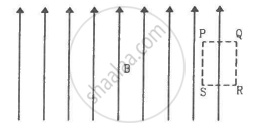
Sometimes we show an idealised magnetic field which is uniform in a given region and falls to zero abruptly. One such field is represented in figure. Using Ampere's law over the path PQRS, show that such a field is not possible.
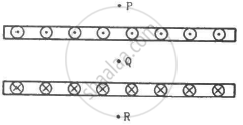
Two large metal sheets carry currents as shown in figure. The current through a strip of width dl is Kdl where K is a constant. Find the magnetic field at the points P, Q and R.
Ampere’s circuital law is given by _______.
A solenoid of length 0.6 m has a radius of 2 cm and is made up of 600 turns If it carries a current of 4 A, then the magnitude of the magnetic field inside the solenoid is:
Ampere's circuital law is used to find out ______
A thick current carrying cable of radius ‘R’ carries current ‘I’ uniformly distributed across its cross-section. The variation of magnetic field B(r) due to the cable with the distance ‘r’ from the axis of the cable is represented by ______
Two identical current carrying coaxial loops, carry current I in an opposite sense. A simple amperian loop passes through both of them once. Calling the loop as C ______.
- `oint B.dl = +- 2μ_0I`
- the value of `oint B.dl` is independent of sense of C.
- there may be a point on C where B and dl are perpendicular.
- B vanishes everywhere on C.
Magnetic fields are produced by:
