Advertisements
Advertisements
प्रश्न
The temperature (T) dependence of resistivity of materials A and material B is represented by fig (i) and fig (ii) respectively. Identify material A and material B.
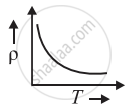 fig. (i) |
 fig. (ii) |
विकल्प
material A is copper and material B is germanium
material A is germanium and material B is copper
material A is nichrome and material B is germanium
material A is copper and material B is nichrome
Advertisements
उत्तर
material A is germanium and material B is copper
APPEARS IN
संबंधित प्रश्न
The order of coloured rings in a carbon resistor is red, yellow, blue and silver. The resistance of the
carbon resistor is:
a) 24 x 106 Ω ± 5%
b) 24 x 106 Ω ± 10%
c) 34 x 104 Ω ± 10%
d) 26 x 104 Ω ± 5%
As the temperature of a metallic resistor is increased, the product of its resistivity and conductivity ____________ .
When a current passes through a resistor, its temperature increases. Is it an adiabatic process?
Is neutral temperature always the arithmetic mean of the inversion temperature and the temperature of the cold junction? Does the unit of temperature have an effect in deciding this question?
The constants a and b for the pair silver-lead are 2.50 μV°C−1 and 0.012μV°C−2, respectively. For a silver-lead thermocouple with colder junction at 0°C, ______________ .
(a) there will be no neutral temperature
(b) there will be no inversion temperature
(c) there will not be any thermo-emf even if the junctions are kept at different temperatures
(d) there will be no current in the thermocouple even if the junctions are kept at different temperatures
An electric kettle used to prepare tea, takes 2 minutes to boil 4 cups of water (1 cup contains 200 cc of water) if the room temperature is 25°C. (a) If the cost of power consumption is Re 1.00 per unit (1 unit = 1000 watt-hour), calculate the cost of boiling 4 cups of water. (b) What will be the corresponding cost if the room temperature drops to 5°C?
The specific resistance of all the metals is the most affected by ______
Which expression gives resistivity \(\rho_T\) at temperature \(T\) in terms of resistivity \(\rho_0\) at reference temperature \(T_0\)?
In the microscopic relation for resistivity, what does \(m\) represent?
