Advertisements
Advertisements
प्रश्न
Is inversion temperature always double the neutral temperature? Does the unit of temperature have an effect in deciding this question?
Advertisements
उत्तर
If the inversion temperature and neutral temperature are measured in degree Celsius, then it is correct to say that "inversion temperature is always double the neutral temperature." When temperature is measured in other units, such as Kelvin, then inversion temperature is not the double of neutral temperature.
APPEARS IN
संबंधित प्रश्न
The thermal energy developed in a current-carrying resistor is given by U = i2 Rt and also by U = Vit. Should we say that U is proportional to i2 or i?
Is work done by a battery always equal to the thermal energy developed in electrical circuit? What happens if a capacitor is connected in the circuit?
Sometimes it is said that "heat is developed" in a resistance when there is an electric current in it. Recall that heat is defined as the energy being transferred due to temperature difference. Is the statement in quotes technically correct?
As the temperature of a metallic resistor is increased, the product of its resistivity and conductivity ____________ .
Two resistors R and 2R are connected in series in an electric circuit. The thermal energy developed in R and 2R are in the ratio ______________ .
An electric kettle used to prepare tea, takes 2 minutes to boil 4 cups of water (1 cup contains 200 cc of water) if the room temperature is 25°C. (a) If the cost of power consumption is Re 1.00 per unit (1 unit = 1000 watt-hour), calculate the cost of boiling 4 cups of water. (b) What will be the corresponding cost if the room temperature drops to 5°C?
Find the thermo-emf developed in a copper-silver thermocouple when the junctions are kept at 0°C and 40°C. Use the data given in the following table.
| Metal with lead (Pb) |
a `mu V"/"^oC` |
b `muV"/("^oC)` |
| Aluminium | -0.47 | 0.003 |
| Bismuth | -43.7 | -0.47 |
| Copper | 2.76 | 0.012 |
| Gold | 2.90 | 0.0093 |
| Iron | 16.6 | -0.030 |
| Nickel | 19.1 | -0.030 |
| Platinum | -1.79 | -0.035 |
| Silver | 2.50 | 0.012 |
| Steel | 10.8 | -0.016 |
A carbon resistor has coloured bands as shown in Figure 2 below. The resistance of the resistor is:
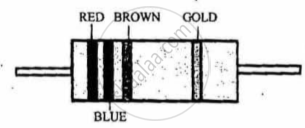
figure 2
Define temperature coefficient of resistance of the material of a conductor.
By increasing the temperature, the specific resistance of a conductor and a semiconductor -
The temperature (T) dependence of resistivity of materials A and material B is represented by fig (i) and fig (ii) respectively. Identify material A and material B.
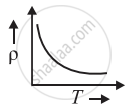 fig. (i) |
 fig. (ii) |
In metals, how does resistivity usually change when temperature increases over a limited temperature range?
What does the temperature coefficient of resistivity, denoted by \(\alpha\), measure?
Which units are given for the temperature coefficient of resistivity?
Which expression gives resistivity \(\rho_T\) at temperature \(T\) in terms of resistivity \(\rho_0\) at reference temperature \(T_0\)?
What happens to electron collisions and relaxation time in metals as temperature rises?
