Advertisements
Advertisements
प्रश्न
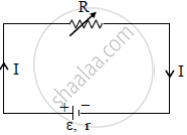
A variable resistor R is connected across a cell of emf ε and internal resistance r as shown in the figure. Draw a plot showing the variation of
(i) Terminal voltage V and
(ii) the current I, as a function of R.
Advertisements
उत्तर
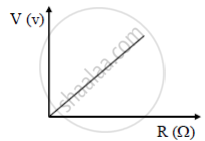
(i) Terminal voltage across a cell as a function of R
As resistance R increases current (I) in the circuit decreases and terminal voltage (V) increases.
We know V = ε –Ir; Where ε is emf of the cell
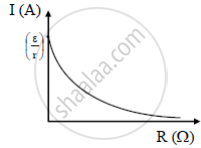
(ii) Current I as a function of R.
The current across a cell is given by `"I" = epsilon/("R"+"r")`
When R increases I decreases
APPEARS IN
संबंधित प्रश्न
A carbon resistor has coloured bands as shown in Figure 2 below. The resistance of the resistor is:
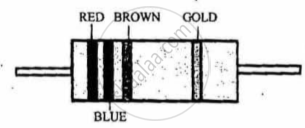
figure 2
An electrical cable of copper has just one wire of radius 9 mm. Its resistance is 5 ohm. This single copper wire of the cable is replaced by 6 different well insulated copper wires each of radius 3 mm. The total resistance of the cable will now be equal to ______.
Which expression gives resistance at a changed temperature?
How is the temperature change \(\Delta T\) defined in the resistance relation?
In the microscopic relation for resistivity, what does \(m\) represent?
For metals such as copper, what is the effect of increasing temperature and the sign of \(\alpha\)?
For alloys such as nichrome, what is the effect of increasing temperature and the sign of \(\alpha\)?
Which linear thermometer relation is used to find the temperature \(t\) when its resistance is \(R_t\)?
